
Most Tampa Bay building owners ask about commercial property management cost before they ask about anything else. It's the right question. The honest answer is that commercial property management costs in Tampa Bay typically range from 3% to 8% of gross collected rents, with meaningful variation based on your property type, tenant mix, and service scope. But the more useful question — the one this post is designed to help you answer — is not "how do I minimize this fee?" It's "What does professional management actually deliver for my NOI?"
This post breaks down every fee structure, what's included versus billed separately, how Tampa Bay's specific market factors affect cost, and how to make a true apples-to-apples comparison between proposals. If you're self-managing and wondering whether the math justifies hiring a PM. This post gives you the cost foundation for that decision.
Understanding Commercial Property Management Fee Structures
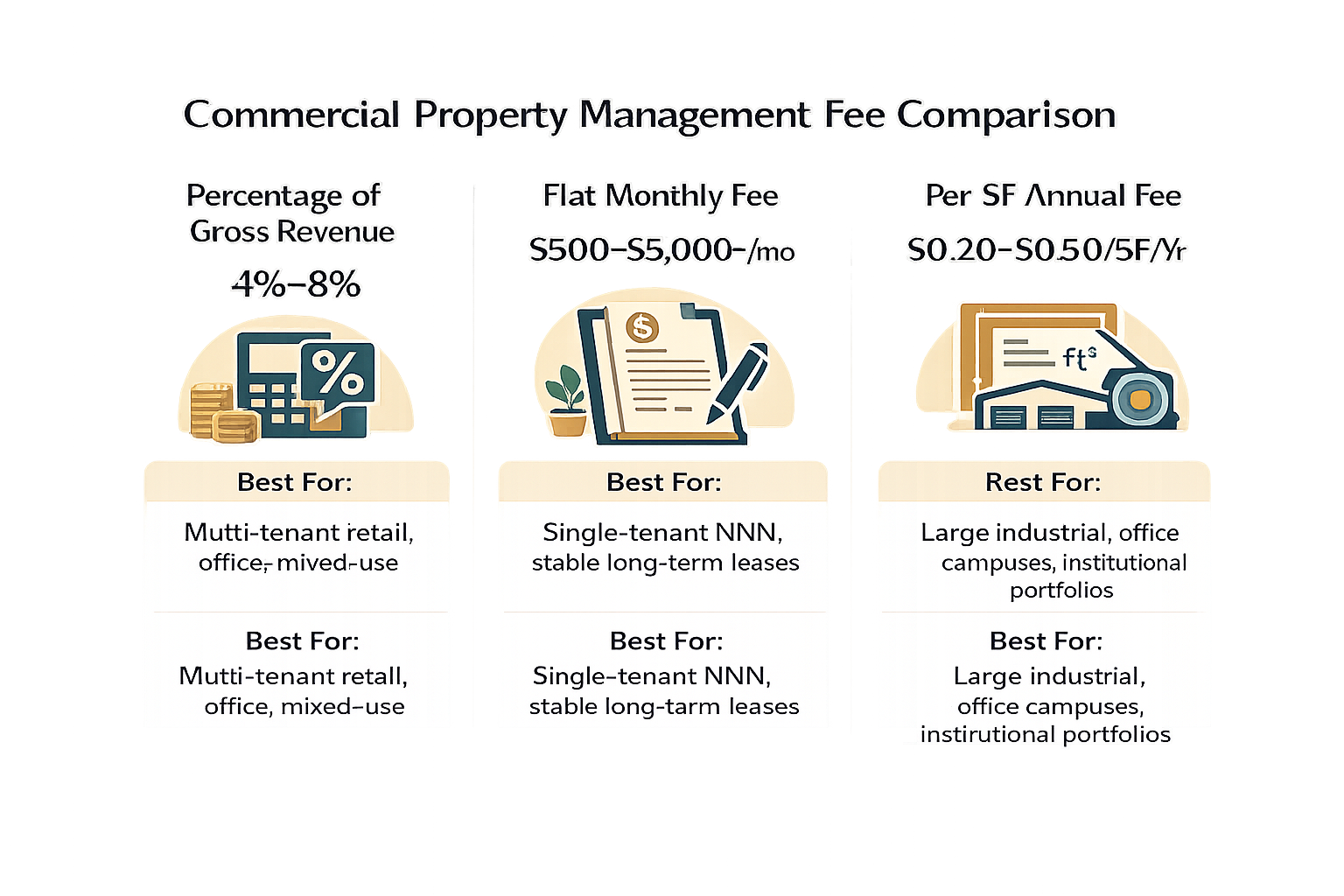
Commercial property management firms use three primary fee models, each with different trade-offs depending on your property profile.
Percentage of Gross Revenue
The most common structure charges a percentage of gross collected rents — typically 4% to 8% for commercial properties in Tampa Bay. This model aligns the manager's compensation with property performance: when occupancy is high and rents are collected efficiently, both the owner and the manager benefit. When vacancy increases, the manager's revenue decreases too, creating a natural incentive to keep the building occupied and tenants paying on time.
According to IREM's Income/Expense Analysis benchmarks and Piping Rock Partners' 2025 analysis of institutional management fees, national averages cluster between 3% and 6% of gross collected rents, with variation by property type — retail centers at 4%–6%, office buildings at 3%–5%, industrial properties at 2%–4%, and mixed-use at 5%–7%. Tampa Bay properties tend to fall within or slightly above these national ranges, reflecting the additional management complexity of hurricane preparedness, Florida's regulatory environment, and a tighter vendor labor market.
Example: A 40,000-SF retail center generating $80,000/month in gross rent at a 5% management fee pays $4,000/month ($48,000/year) for base management services. If the manager increases occupancy or negotiates higher rents, their fee grows — but so does your revenue.
Flat Monthly Fee
Some firms charge a fixed monthly rate regardless of revenue fluctuations. This model is common for single-tenant NNN (triple net) properties, where the tenant handles most operating expenses directly, and the manager's scope is narrower — focused primarily on lease administration, financial reporting, and periodic inspections.
Flat fees in Tampa Bay typically range from $500 to $5,000+ per month, depending on property size and complexity. The advantage is budget certainty; the trade-off is that the manager's compensation is not tied to performance outcomes.
Per-Square-Foot Fee
For larger portfolios — institutional industrial parks, office campuses, or multi-building commercial properties — some managers charge on a per-square-foot basis, typically $0.20 to $0.50/SF annually. This structure scales directly with property size and is most common in institutional arrangements where portfolio scale creates operational efficiencies.
Example: A 100,000-SF industrial portfolio at $0.30/SF/year costs $30,000 annually in base management fees — a figure that can be benchmarked directly against comparable institutional portfolios.
Fee Comparison Table
|
Fee Model |
Tampa Bay Range |
Pros |
Cons |
Best For |
|
% of Gross Revenue |
4%–8% |
Aligns incentives; scales with income; manager motivated to maximize occupancy |
Cost increases as rents grow; less predictable for budgeting |
Multi-tenant retail, office, mixed-use |
|
Flat Monthly Fee |
$500–$5,000+/mo |
Budget certainty; simple to forecast; predictable cash flow impact |
No performance incentive; may overpay during high vacancy |
Single-tenant NNN, stable long-term leases |
|
Per-SF Annual Fee |
$0.20–$0.50/SF/yr |
Scales with property size; easy to benchmark; transparent |
Less common for smaller properties; doesn't reflect revenue performance |
Large industrial, office campuses, institutional portfolios |
What Drives Fee Variation by Property Type?
Not all commercial properties require the same management intensity. A 20-tenant retail center with daily customer traffic, complex CAM allocations, and hours-of-operation requirements is fundamentally more management-intensive than a single-tenant warehouse on a 10-year NNN lease. Here's how typical fee ranges break down by asset class:
|
Property Type |
Fee Range |
Key Drivers |
|
Retail Center |
4%–7% |
High tenant interaction, complex CAM reconciliations, common-area oversight, customer-facing maintenance |
|
Office Building |
3%–5% |
Amenity and common-area management, HVAC complexity, janitorial oversight, conference space coordination |
|
Industrial/Warehouse |
2%–4% |
Lower-touch operations, simpler lease structures, fewer tenants, and tenants often handle interior maintenance |
|
Mixed-Use |
5%–8% |
Multiple asset types requiring different management approaches, complex CAM across residential/commercial components |
|
Flex Space |
3%–5% |
Variable tenant mix, moderate operational demands, and higher turnover potential than pure industrial |
The variation within each range depends on portfolio size (larger portfolios often negotiate lower rates), property age and condition (older buildings require more maintenance oversight), tenant quality, and the depth of services included in the base fee.
What's Included in the Base Fee vs. Additional Charges
Understanding what's bundled into your base management fee — and what triggers extra charges — is critical for comparing proposals accurately. A firm quoting 4% with extensive add-on fees may cost more annually than a firm quoting 6% with a more inclusive scope.
Typically Included in Base Fee
- Monthly rent collection and accounts receivable management
- Tenant communication, relationship management, and complaint resolution
- Routine maintenance coordination and vendor dispatch
- Monthly financial reporting (income statement, rent roll, A/R aging, variance analysis)
- Lease administration and critical date tracking
- Quarterly property inspections with documented reports
- Annual operating budget preparation
- Insurance claims coordination
- Regulatory compliance monitoring and inspection scheduling
- Leasing fees: 4%–6% of gross lease value for new leases; 1%–3% for renewals. In Tampa Bay's office market, where leasing activity reached nearly 5 million SF in 2025 per BOMA Greater Tampa Bay data, this is a meaningful but often necessary cost when filling vacant space.
- Capital improvement oversight: 5%–10% of project cost. Covers bidding, contractor supervision, quality control, and budget management for major projects.
- Construction management for TI build-outs: 5%–15% of construction cost, covering plan review, contractor coordination, and punch-list management.
- Eviction coordination: $500–$2,000+, depending on complexity.
- After-hours emergency response: Some firms include 24/7 coverage in the base fee; others charge $150–$300 per incident or a separate retainer.
- CAM reconciliation preparation: $500–$1,500 per property annually, depending on complexity.
- Technology or platform fees: Some firms charge $50–$200/month for owner-facing software portals and reporting platforms — worth asking about explicitly in any proposal review.
Commonly Charged Separately
At Gain Property Group, transparent pricing is a non-negotiable standard. Every engagement starts with a complete fee schedule — no line item added after the relationship begins. Owners should never have to guess what their management is costing them.
Want ongoing market intelligence on Tampa Bay commercial rents, operating costs, and compliance updates delivered directly to your inbox? Our monthly newsletter is free and useful whether you manage your own properties or work with a PM.

The Fee as an NOI Line Item — Not Just an Expense
The commercial property management cost in Tampa Bay is not just a line item to minimize — it is a variable that directly shapes your net operating income. Consider the math on a 40,000-SF office building where professional management lifts occupancy from 88% to 95% — a realistic delta in Tampa Bay's current market, where Trophy and Class A asking rents in core Tampa Bay submarkets rose 7.1% year-over-year to $45.46/SF, according to JLL's Q4 2025 market report. That occupancy improvement generates more incremental revenue in a single quarter than the annual management fee costs. At renewal, a PM who benchmarks current market rents and tracks escalation schedules will consistently negotiate stronger terms than an owner managing a dozen other things from a spreadsheet.
The costs on the other side of the ledger matter equally. Deferred maintenance — the $2,000 HVAC repair that becomes a $20,000 replacement because no one tracked a preventive maintenance calendar — is an NOI hit that never appears in a management fee comparison. Missed lease escalations compound annually. A compliance gap (fire safety, ADA, stormwater) can generate penalties that exceed a year of management fees. The right question is not "what does this fee cost me?" but "what is the total NOI impact of professional management versus the alternative?".
Tampa Bay-Specific Cost Factors
Several regional factors influence commercial property management cost in Tampa Bay and explain why fees here may differ from national averages.
Insurance Management Complexity
Florida's commercial property insurance market has gone through genuine turbulence in recent years — but the picture as of 2025–2026 is materially better than it was. Since reforms were enacted, 17 new property and casualty insurers have entered the Florida market, with additional carriers, reinsurers, and specialty entities continuing to gain approval through early 2026. Citizens' policy count has dropped more than 70% from its 2023 peak. Property insurance litigation fell approximately 25% in the first half of 2025 compared to the prior year, continuing a multi-year decline since reforms were enacted. And property and casualty insurance costs in Florida are estimated to be roughly 14.5% lower than they would have been without the 2022–2023 reforms, according to a Perryman Group analysis. The market is stabilizing — but it remains structurally complex compared to most other states.
For Tampa Bay building owners, insurance management still requires carrier relationships, strategic coverage decisions, and active claim coordination that landlocked markets don't demand. The complexity is real, even as conditions improve — and it remains a component of the management scope that benefits from professional handling.
Hurricane Season Preparedness
Every Tampa Bay commercial property needs a documented hurricane preparedness plan, and professional property managers execute it: pre-storm preparation, tenant communication, generator testing, post-storm damage assessment, and insurance adjuster coordination. This seasonal burden spans June through November and justifies a portion of the management fee that national benchmarks don't account for.
Rising Vendor Costs and a Tight Trades Market
Tampa Bay's sustained growth has created a meaningful shortage of skilled trades — HVAC technicians, electricians, plumbers, and roofers are all in high demand across both residential and commercial sectors. A property manager with established vendor relationships and volume-based pricing agreements can often negotiate meaningful discounts through those networks that individual owners lack access to. The overall trend in vendor costs is still upward, and this is a real component of total management expense that belongs in any honest cost projection.
Regulatory Complexity
Stormwater management requirements, fire safety protocols, ADA enforcement, and building recertification timelines have all grown more demanding as Tampa Bay's municipalities expand. A professional PM tracks these systematically. Self-managing owners typically build those systems reactively — after a deadline is missed or a violation is issued — which costs more than staying ahead of them.
 How to Compare Proposals: Looking Beyond the Base Rate
When evaluating property management proposals, the base management fee is only part of the picture. Here is a framework for making a true comparison:
- Request a complete fee schedule — every possible charge, not just the headline rate. Ask specifically about leasing fees, maintenance markups, project management fees, technology fees, and after-hours charges.
- Model total annual cost based on your property's actual operations. If you expect to sign two new leases and complete one capital project this year, model those costs against each proposal to understand the all-in expense.
- Ask about maintenance markups — 10%–15% is standard and covers vendor coordination overhead. Above that threshold, ask for a clear explanation of what additional value it provides.
- Understand leasing economics — how are commissions structured, do they use co-brokers, and how are those splits handled? In Tampa Bay's competitive leasing environment, this can be a significant annual line item.
- Evaluate reporting quality — minimal reporting often costs more through missed opportunities than the savings on a lower fee. Ask to see sample monthly reports.
As BOMA's operational best practices note, management fee analysis should consider total cost of management — not just the management agreement fee — including the impact of management quality on vacancy rates, operating expenses, and tenant retention. A manager who costs 2% more but delivers 5% higher occupancy is generating net value.
Key Takeaways
- Always ask for a complete fee schedule — not just the base management rate. A 4% proposal with heavy add-ons can easily cost more annually than a 6% proposal with inclusive scope.
- Model your total annual management cost based on your property's actual operations: expected lease activity, planned capital projects, and current vendor spend.
- Frame the management fee as an NOI line item, not just an expense. Professional management that improves occupancy, controls operating costs, and captures lease escalations can be net-positive to your NOI even after the fee.
- Tampa Bay's insurance complexity, hurricane exposure, tight vendor market, and evolving municipal requirements justify management fees that may exceed national benchmarks.
- The most expensive property management mistake isn't overpaying for good management — it's underpaying for mediocre management, or assuming that no fee means no cost
Schedule a Free Property Assessment
Understanding what professional property management will actually cost — and what it will deliver — requires looking at your specific property, tenant mix, and operating situation. Not every property needs the same level of management, and not every fee structure fits every portfolio.
Gain Property Group offers a free Property Assessment for Tampa Bay commercial property owners. We'll evaluate your current operations, benchmark your costs against current market data, and give you a clear picture of what professional management looks like for your specific assets. No sales pitch — just an honest analysis you can use, whether you hire us or not.
[Schedule Your Free Property Assessment ->]
Related Reading
From our blog:
- Commercial Property Management in Tampa Bay: A Guide for Owners — The full framework for evaluating, hiring, and working with a commercial PM in Tampa Bay
Industry resources:
- IREM Income/Expense Analysis — Benchmarking data on commercial management fees and operating expenses by property type
- Building Owners and Managers Association (BOMA) — Operational best practices for commercial building management
- NAR Commercial Real Estate Market Insights — National commercial real estate market data and trends


