
It starts with a phone call on a Sunday morning. Your HVAC contractor can't make it until Thursday, your tenant's lease renewal is three weeks overdue, and you just found out the county updated its fire inspection requirements — again. You bought this building to generate income and build wealth. Instead, you're spending your Tuesday mornings negotiating vendor bids and your Thursday evenings reviewing maintenance invoices.
If any of that sounds familiar, you're not alone. Most commercial building owners in Tampa Bay reach a point where the time and energy required to manage their property exceeds what they planned for when they first made the investment. Commercial property management in Tampa Bay is more demanding than most owners anticipate — and the consequences of getting it wrong show up in your bottom line, your tenants' satisfaction, and your own quality of life.
This guide covers what commercial property management actually involves, what it costs in today's Tampa Bay market, how to evaluate management firms, and where local conditions create specific risks and opportunities. Whether you own a single retail center on Dale Mabry or a portfolio of flex spaces along the I-75 corridor, the goal is the same: protect your asset, maximize your returns, and reclaim your time.
We've organized this guide to link to our deeper dives on specific topics, so you can explore any area in detail.

What Is Commercial Property Management?
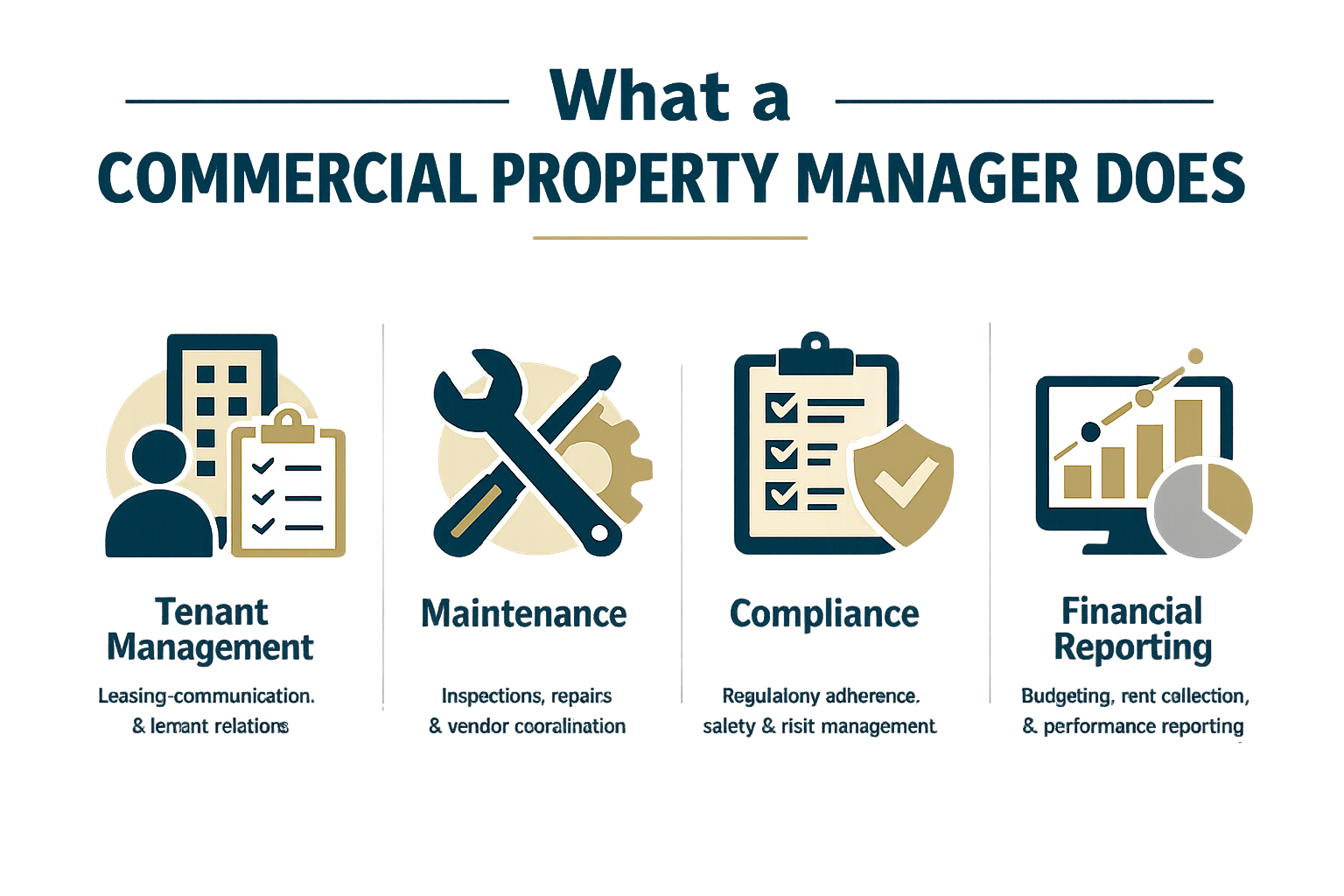
Commercial property management is the professional oversight of income-producing real estate — office buildings, retail centers, industrial warehouses, mixed-use developments, and flex spaces. If you've come from the residential side, the commercial world operates differently. Lease cycles are longer (often five to ten years), tenant improvement negotiations are more complex, operating expense reconciliations require careful accounting, and regulatory requirements vary depending on the type of building you own.
At its core, a commercial property manager serves as the operational bridge between your financial goals and the day-to-day realities of running a building. That includes collecting rent and enforcing lease terms, but it also extends to coordinating capital improvement projects, managing vendor relationships, maintaining regulatory compliance, and providing the financial reporting you need to make informed decisions about your asset.
The industry's professional standards are set by two organizations worth knowing. The Institute of Real Estate Management (IREM) awards the Certified Property Manager (CPM) designation, which is widely regarded as the gold standard for commercial property managers. The Building Owners and Managers Association (BOMA) establishes the measurement and operational standards that govern how commercial space is classified and managed — including the methodology for calculating rentable area, which directly affects your lease economics and revenue.
When we discuss how to evaluate property management companies later in this guide, these credentials will matter. For now, the key point is that commercial property management is a specialized discipline, and the difference between competent professional management and a hands-off or under-resourced approach shows up directly in your operating income.
Why This Matters Right Now in Tampa Bay
Tampa Bay's commercial real estate market is moving in several directions at once, and each trend creates different management demands depending on the type of property you own.
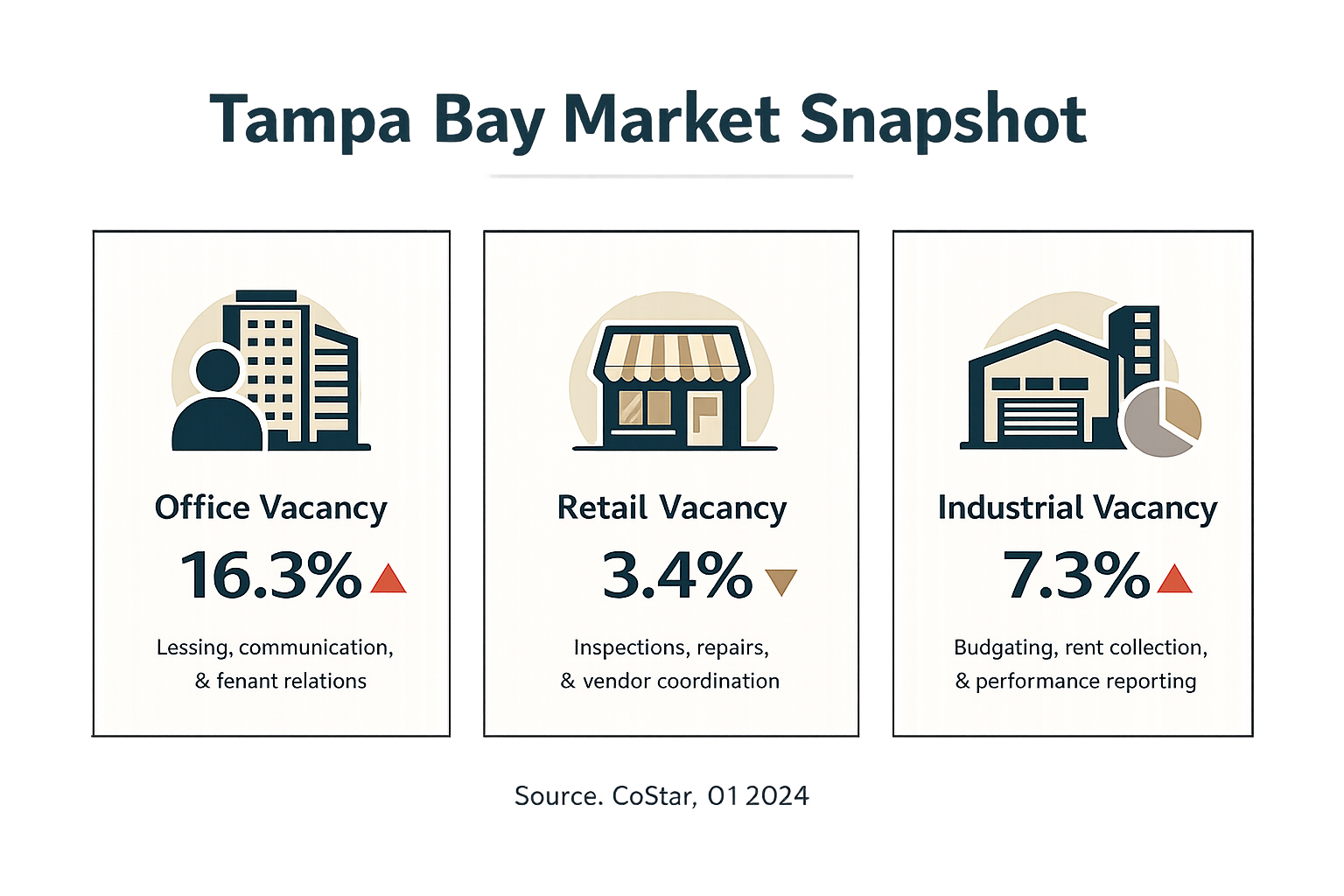
The office market is in a correction. According to BOMA Greater Tampa Bay data from early 2026, the direct office vacancy rate stood at 16.3%, with total vacancy near 19%. Leasing activity neared 5 million square feet in 2025, with the Westshore business district and I-75 corridor leading activity, but average asking rents vary dramatically — from $51 per square foot for trophy space to approximately $26 per square foot for Class B, per Avison Young data. (Note: some brokerages report somewhat different figures depending on methodology — Newmark's Q4 2025 data shows an overall vacancy rate of 15.5% using a different sample set.) If you own office space in Tampa Bay, you're operating in a market where tenant retention is critical, and every vacancy costs more than it did three years ago. Proactive lease renewal processes, responsive maintenance, and competitive amenity positioning aren't optional — they're how you protect your income.
Retail is the strongest-performing asset class in the region. Vacancy is hovering around 3.4% as of early 2026, and some premium corridors in South Tampa and Westshore dip below 3%. Average asking rents have pushed to approximately $27.50 to $28.00 per square foot — driven by virtually no new construction and the Tampa-St. Pete-Clearwater metro area's addition of more than 240,000 new residents in the four-county area since 2020 (and nearly 500,000 across the broader eight-county Tampa Bay region). For retail owners, this is a favorable environment, but it demands sophisticated lease administration to capture every dollar of rent growth at renewal. Leaving money on the table in a sub-4% vacancy market is an expensive missed opportunity.
Industrial is absorbing new supply. The industrial vacancy rate reached 7.3% in early 2026 — a decade high according to CoStar/Matthews data — largely due to new deliveries in Plant City and the Eastside rather than weakening demand. Net absorption has rebounded strongly, and the development pipeline has cooled, which is expected to protect landlord pricing power as the current supply wave is absorbed. For industrial owners, the priority is monitoring competitive deliveries in your submarket and positioning your property to maintain occupancy.
The common thread across all three asset classes is that each situation requires market intelligence, operational expertise, and the kind of vendor and tenant relationships that take years to develop. A one-size-fits-all management approach does not work in a market this varied.
What Professional Property Management Costs in Tampa Bay
Cost is usually the first question owners ask, and it deserves an honest answer. Here is the framework. We cover this in detail in How Much Does Commercial Property Management Cost in Tampa Bay?, but here is the framework.
Fee Structures
Commercial property management firms typically charge using one of three models:
|
Fee Structure |
Typical Range |
Best For |
|
Percentage of gross revenue |
3%–8% |
Multi-tenant properties with variable income |
|
Flat monthly fee |
$500–$5,000+/month |
Single-tenant NNN leases or stable portfolios |
|
Per-square-foot fee |
$0.20–$0.50/SF/year |
Large industrial or office portfolios |
Industry data from IREM's Income/Expense Analysis shows that most commercial management fees fall between 3% and 6% of gross collected rents. Retail and mixed-use properties tend to command higher fees (4%–7%) because of their operational complexity — more tenants, more lease structures, more moving parts. Industrial buildings, which are typically lower-touch, often fall at the lower end (2%–4%). Office properties generally land in the 3%–5% range.
Percentage-based fees are the most common because they naturally align the manager's incentive with your property's performance: when occupancy is high and rents are collected efficiently, both of you benefit.
What's Included vs. What Costs Extra
Base management fees usually cover rent collection, tenant communications, routine maintenance coordination, financial reporting, and lease administration. Services that typically carry additional fees include leasing commissions (3%–6% of total lease value for new leases, 1%–2% for renewals), capital improvement project management (5%–10% of project cost), construction oversight for tenant build-outs (5%–15% of construction cost), eviction coordination ($500–$2,000+), and CAM reconciliation preparation ($500–$1,500 annually if not bundled).
Understanding the full fee picture — not just the base rate — is essential for comparing proposals. Two firms quoting 4% and 6% respectively may deliver very different total annual costs once add-on fees are factored in. In our experience, the most common source of sticker shock isn't the management fee itself — it's the leasing commissions and maintenance markups that weren't clearly explained upfront.
Tampa-Specific Cost Factors
Several local factors influence management costs in this region. After years of volatility, Florida's commercial property insurance market is showing signs of stabilization in 2026, with several carriers filing for rate reductions — though premiums remain above national averages, and managing carriers, claims, and renewals still demands specialized knowledge. Hurricane season adds operational complexity that doesn't exist in inland markets: seasonal storm preparation, emergency response protocols, and post-storm restoration coordination are annual requirements, not rare events. Tampa Bay's rapid growth has also led to tightened code enforcement and permitting requirements across Hillsborough, Pinellas, and Pasco counties. And skilled maintenance technicians are in high demand region-wide, driving up vendor costs for HVAC, electrical, plumbing, and general contracting.
Want to know what professional management would actually cost for your building? We'll run the numbers for free as part of a complimentary property assessment — no obligation, just a clear picture of what you'd be working with.
The Six Core Services a Property Manager Should Provide
A comprehensive commercial property management engagement covers six core areas. Here is what to expect.
Tenant Management
This encompasses the full tenant lifecycle — marketing vacant space, screening prospective tenants, negotiating lease terms, managing move-ins, handling day-to-day tenant relations, processing renewals, and coordinating move-outs. In commercial settings, it also includes tenant improvement coordination and ensuring that build-outs comply with lease specifications and building codes.
Tenant management matters because retention is one of the most powerful levers for protecting your net operating income. The cost of losing a commercial tenant — lost rent during vacancy, tenant improvement allowances for the replacement, leasing commissions, and marketing expenses — can easily equal 12 to 18 months of rent. (This figure is actually conservative for commercial properties: on a 5,000-square-foot space at $25 per square foot, the combination of TI allowances, vacancy period, and leasing commissions can approach two years of rent equivalent. The components include TI, downtime, commissions, and marketing.) In Tampa Bay's office market, where vacancy already sits near 19%, losing a tenant to poor communication or slow maintenance response is an avoidable and expensive mistake. In the retail market, where vacancy is below 3.5%, strong tenant relationships position you to capture maximum rent growth at renewal time.
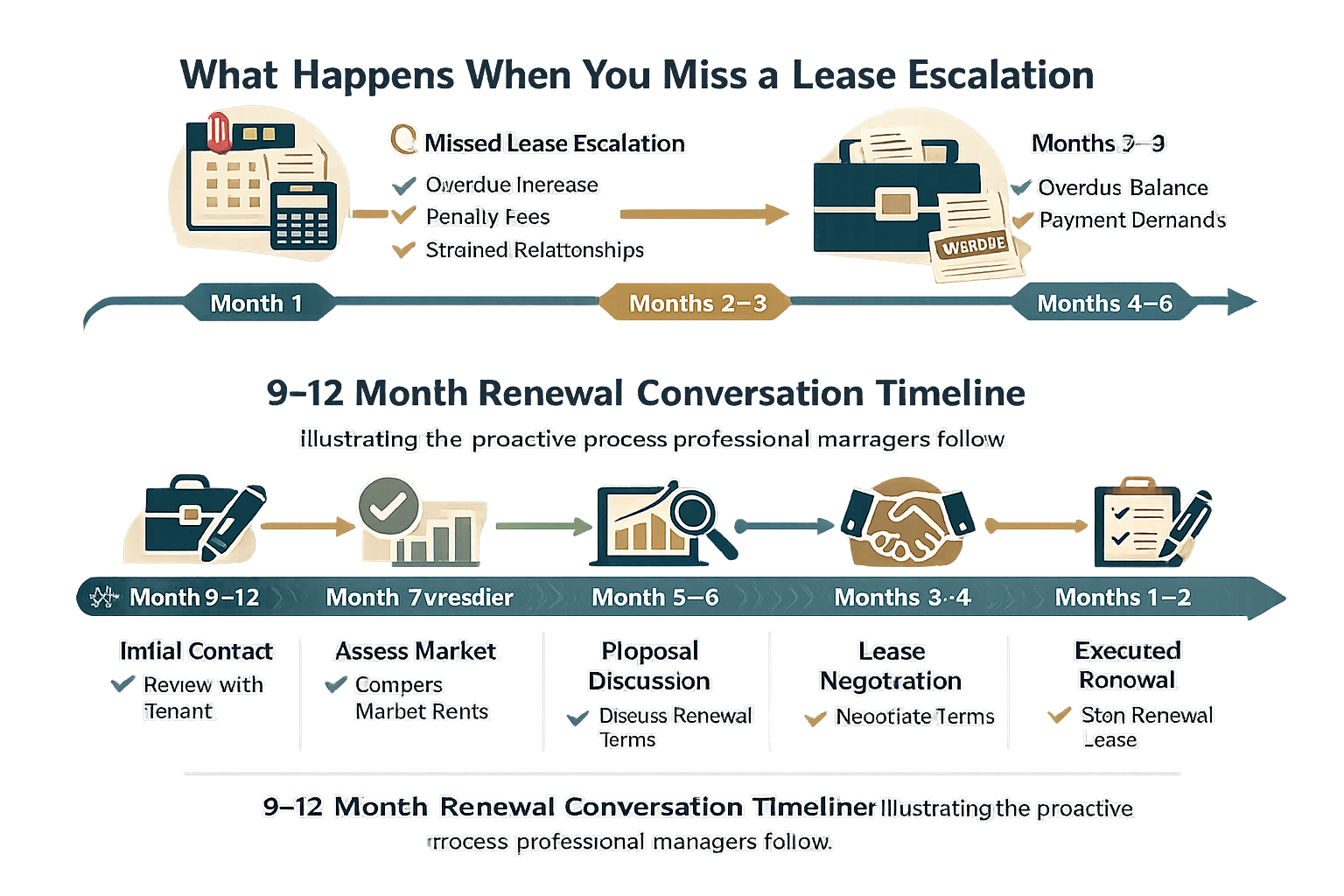
Professional property managers typically begin renewal conversations 9 to 12 months before lease expiration, conduct regular tenant satisfaction check-ins, and maintain dedicated points of contact for each property. These aren't luxuries — they're the practices that keep occupancy high and turnover costs low. Professional managers typically target retention rates above 70% for well-managed commercial properties, though actual performance varies by asset class, market conditions, and lease term length.
Maintenance and Repairs
Effective maintenance programs balance reactive repairs (fixing what breaks) with preventive maintenance schedules (catching problems before they become emergencies). BOMA's operational standards emphasize the importance of preventive maintenance in extending equipment life and reducing long-term costs. Industry estimates suggest that a structured preventive maintenance program reduces lifecycle costs by 15%–25% compared to a reactive-only approach — and some sources, including U.S. Department of Energy data, point to potential savings well above this range for properties with historically deferred maintenance.
A professional PM should maintain a documented maintenance calendar covering HVAC systems, roofing, elevators, fire suppression, parking areas, and building envelope components. Equally important, they should have vendor relationships that deliver competitive pricing and reliable response times — something that only comes from years of local presence and consistent volume.
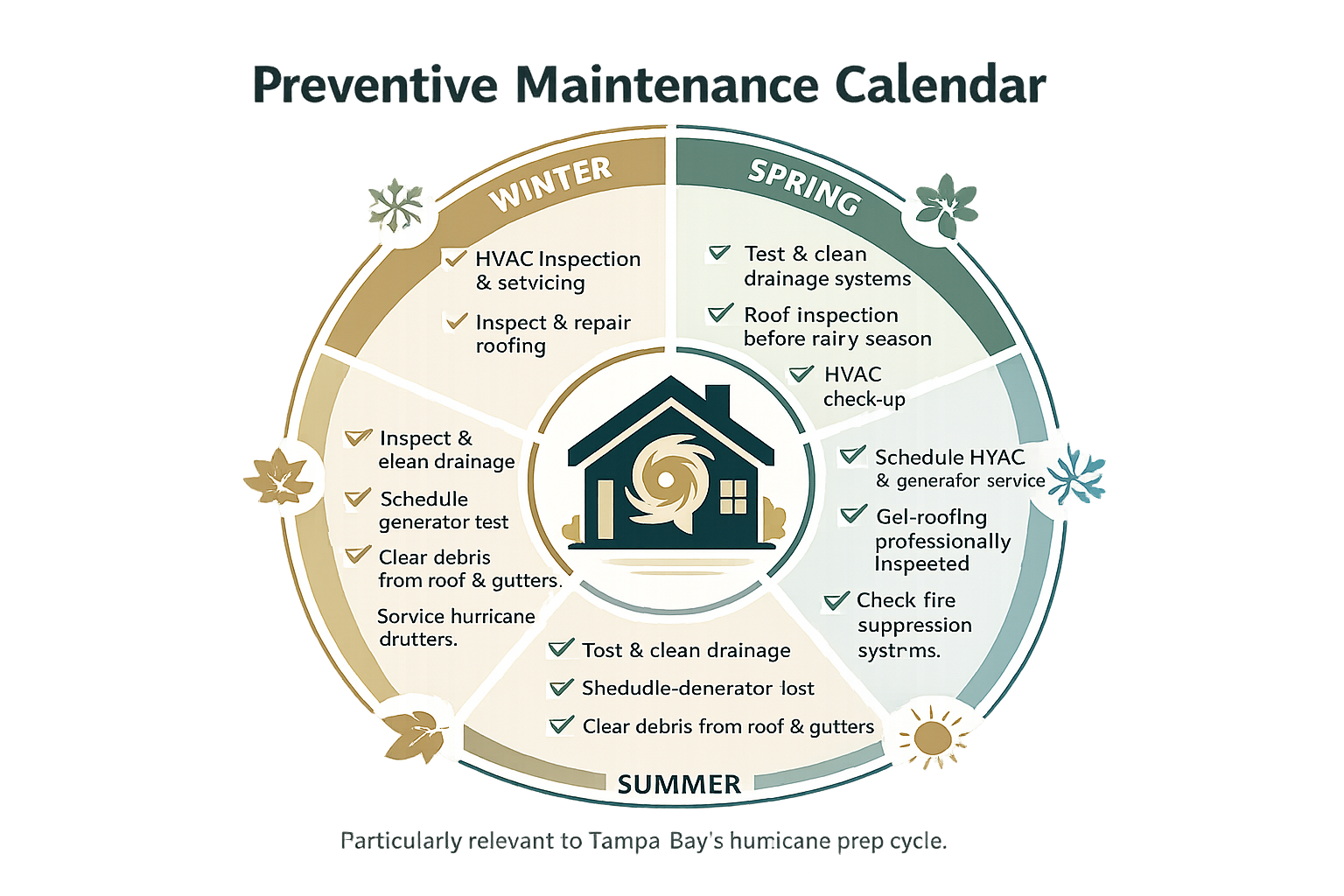
In Tampa Bay specifically, Florida's climate creates maintenance urgencies that don't exist in other markets. Summer temperatures regularly exceed 95°F, which means an HVAC failure isn't a minor inconvenience — it's a tenant retention crisis. Salt air along the coast in Clearwater and St. Pete accelerates corrosion on rooftop equipment and building exteriors. And hurricane season demands annual preparation: testing generators, inspecting roofs, clearing drainage systems, and securing outdoor elements. A property manager who understands these realities plans for them in advance rather than reacting to them in the moment.
Financial Reporting and Accounting
At a minimum, you should expect monthly reporting that includes an income statement, balance sheet, accounts receivable aging, rent roll, variance analysis against budget, and cash flow projections. Quarterly and annual reporting should include CAM reconciliation statements, capital expenditure tracking, and budget-to-actual performance reviews.
Quality financial reporting transforms property management from a cost center into a strategic function. When you can see exactly where your money is going, compare your operating expenses against IREM benchmarks for similar Tampa Bay properties, and track your actual performance versus your budget, you can make informed decisions about capital improvements, lease negotiations, and whether it's the right time to hold or sell. If your operating expense ratio is running 15% above the benchmark for comparable properties, that's a signal worth investigating — and the kind of insight that only surfaces with consistent, detailed reporting.
Compliance and Risk Management
Florida's regulatory environment creates specific obligations for commercial property owners, and the penalties for noncompliance are real. Property managers in Florida who handle rentals for others and receive compensation must hold a real estate broker's license under Florida Statutes Chapter 475. Buildings are subject to regular inspections covering fire safety systems, ADA accessibility, elevator certifications, and structural integrity — missing a deadline can trigger fines or even occupancy restrictions.
Environmental compliance includes mandatory radon gas disclosures under F.S. 404.056(5), asbestos management protocols in older buildings, and mold remediation standards that must follow state and federal guidelines. Insurance is its own challenge: maintaining adequate coverage in Florida's market, including windstorm and flood policies where required, is a complex and time-sensitive process. Many Tampa Bay commercial properties fall within FEMA flood zones, making flood insurance a critical consideration.
ADA compliance is a common area of liability, especially in older buildings along corridors like Kennedy Boulevard and in historic districts like Ybor City.
On premises liability and security: Florida law addresses the responsibility of property owners differently depending on the type of property. For commercial properties, Florida Statute 768.0701 establishes a comparative fault framework for liability when criminal acts by third parties occur on the premises. For multifamily residential properties with five or more dwelling units, Florida Statute 768.0706 — enacted as part of the 2023 tort reform legislation (HB 837) — creates a rebuttable presumption in favor of property owners who implement qualifying security measures, including CPTED-certified assessments, security cameras, and proper exterior lighting. This presumption applies specifically to residential multifamily buildings and does not extend to commercial-only properties such as office, retail, or industrial buildings. Commercial property owners should consult qualified legal counsel to understand their specific liability exposure and the security investments most likely to reduce it.
The statewide mandate introduced under SB 4-D (2022) requires milestone structural inspections for condominium and cooperative buildings three stories or taller — commercial-only properties are not subject to the same requirement. However, the broader trend toward increased structural inspection scrutiny has practical implications for all commercial owners, particularly those with mixed-use properties that include condominium components. Proactive structural assessments reflect sound asset management regardless of legal mandate.
Lease Administration
Lease administration goes well beyond collecting rent on time. It includes tracking critical dates — expirations, renewal option windows, rent escalation triggers — as well as managing CAM reconciliations, monitoring tenant compliance with lease terms (operating hours, signage requirements, permitted use clauses), and coordinating estoppel certificates during property sales or refinancing.
For multi-tenant properties, this function is particularly complex and consequential. Consider a 50,000-square-foot retail center with 12 tenants. That's 12 different lease structures, escalation schedules, and CAM allocation formulas — each requiring accurate tracking and timely execution. Miss a 3% annual rent escalation on a $20/SF lease for 5,000 SF, and you've lost $3,000 in the first year. That compounds annually, and across a portfolio, the cumulative revenue loss can reach tens of thousands of dollars — money that simply evaporates because nobody was watching the calendar.
Vendor Management
Professional property managers maintain a network of licensed, insured vendors across every service category — HVAC, plumbing, electrical, landscaping, janitorial, security, pest control, and specialized trades. This provides three advantages that most individual owners cannot replicate on their own.
First, competitive pricing through volume relationships. Over a 10-year hold, the difference between competitive and retail vendor pricing can amount to 8%–12% of total maintenance spend — a meaningful number on any property. Second, reliable response times from vendors who value the ongoing relationship — this matters most during emergencies and hurricane season, when everyone in Tampa Bay is calling the same contractors. Third, quality accountability from vendors who understand that subpar work means losing a steady stream of business.
Effective vendor management also includes competitive bidding for major contracts, insurance certificate verification, and ongoing performance monitoring — all of which reduce your cost and risk over time.
How to Choose the Right Property Management Company
Selecting a property management firm is one of the most consequential decisions you'll make as a building owner. The wrong choice shows up in lost tenants, deferred maintenance headaches, and missed revenue. The right choice can turn your property from a time-consuming burden into a well-managed asset that builds wealth while you focus on other priorities — including acquiring your next property.
What to Evaluate
Experience and specialization. Does the firm manage properties similar to yours? A company that specializes in multifamily will approach a retail center very differently from a firm with deep retail experience. Ask for a current portfolio list and references from owners with comparable assets in similar Tampa Bay submarkets.
Local market knowledge. In Tampa Bay, understanding submarket dynamics is critical — the Westshore office corridor and the Brandon retail market are different worlds with different tenant demand drivers, competitive properties, and prevailing lease terms. Your property manager should be able to tell you what comparable space is leasing for in your submarket without looking it up.
Technology and reporting. Ask to see sample reports and understand what platforms the firm uses for accounting, maintenance tracking, tenant portals, and owner reporting. The best firms provide online owner portals with real-time access to financial data, maintenance status, and lease information.
Team structure and stability. Understand who will actually manage your property day-to-day. Large firms may offer brand-name credibility, but assign your asset to a junior manager handling 15 or more properties. Smaller firms may provide more attention but lack depth for emergencies. Ask about average portfolio load per manager and staff turnover rates.
Fee transparency. Request a complete fee schedule — not just the base management rate. Understand how leasing fees, maintenance markups, project management fees, and administrative charges work. The lowest base rate often comes with the most add-on fees. If maintenance markups exceed 15%, ask for an explanation.
Industry credentials. Look for firms with CPM designations from IREM and active involvement with BOMA Greater Tampa Bay. These credentials indicate a commitment to professional standards, continuing education, and industry best practices.
Questions Worth Asking
When you're evaluating firms, these are the questions that separate a thorough vetting process from a cursory one: What is your average tenant retention rate for properties similar to mine? How do you handle after-hours emergencies, and what's your response time commitment? Can you show me a sample monthly owner report from a comparable property? How do you approach competitive bidding on maintenance contracts? How many properties does the assigned manager currently oversee? How do you handle capital improvement recommendations — what triggers one and how do you present the ROI case? What does your transition process look like for onboarding a new property? How do you stay current with Tampa Bay's evolving regulatory requirements? Can you provide references from owners who have been with you for three or more years?
The answers to these questions will tell you far more than a polished sales presentation.
Patterns That Cost Tampa Bay Owners Money
In our work managing commercial properties across Tampa Bay, we see several recurring patterns that erode property value and net operating income.
Deferring maintenance to save money. This is one of the most expensive "savings" in commercial real estate. A $3,000 HVAC repair deferred today often becomes a $25,000 system replacement next year — and a tenant who decides not to renew because the building "isn't maintained well." Florida's heat and humidity accelerate equipment degradation, making preventive maintenance even more critical here than in cooler climates. A roof leak you ignore in March can become a mold remediation project by August.
Leaving rent below market. In a market where retail vacancy is below 3.5% and industrial demand remains strong, renewing tenants below market rate is leaving real money behind. Many self-managing owners lack access to real-time market data and comparable lease analysis, and the result is renewals that don't reflect current conditions. Even a 5% below-market renewal on a $25/SF retail lease for 3,000 SF represents $3,750 in lost annual revenue — per tenant.
Falling behind on compliance. From fire safety inspections to ADA accessibility to environmental disclosures, commercial properties carry real compliance obligations. A missed inspection or expired permit can result in fines, lawsuit exposure, or orders to vacate in extreme cases. Florida's unique requirements around radon, windstorm insurance, and increasingly scrutinized structural inspection practices make this an area where professional oversight provides genuine protection.
Operating without an emergency plan. Tampa Bay's hurricane exposure makes emergency preparedness non-negotiable. Owners who lack documented storm preparation protocols, vendor emergency contacts, and post-storm assessment procedures put both their tenants and their assets at risk. The time to build these systems is before hurricane season begins — not when the first cone appears over the Gulf.
Choosing a property manager based on price alone. A property manager charging 3% who misses lease escalations, defers maintenance recommendations, and fails to retain tenants will cost you far more than a 5% manager who protects and grows your NOI. What matters is the total cost of management — including the financial impact of management quality on your income, your vacancy rate, and the long-term condition of your asset.
For a more honest comparison of doing it yourself versus hiring professional management, read Self-Managing vs. Hiring a Property Manager: A Tampa Owner's Honest Comparison.
Tampa Bay Market Context: Why Local Expertise Matters
Tampa Bay is not a single market — it's a collection of distinct submarkets, each with its own demand drivers, tenant profiles, and competitive dynamics. A property manager without deep local knowledge is working at a disadvantage.
Westshore Business District is the region's premier office corridor, leading in leasing activity and home to the highest Class A rents. Trophy office space here commands over $51 per square foot, and the management requirements — sophisticated tenant relations, competitive amenity programs, proactive lease structuring — reflect the caliber of tenants who occupy this space. What works in Westshore often diverges significantly from the broader Tampa Bay average.
Downtown Tampa is experiencing a renaissance, driven by mixed-use development, growing residential density, and corporate relocations. The Water Street Tampa development has reshaped expectations for the submarket. Managing properties downtown means navigating complex urban challenges: parking management, pedestrian access, municipal permitting, and coordination with ongoing infrastructure investment.
Ybor City is a historic district with unique zoning, preservation requirements, and a tenant mix that ranges from restaurants and nightlife to creative offices and boutique retail. Managing here demands familiarity with the Tampa Historic Preservation Commission's requirements and the neighborhood's distinct character.
Brandon and Riverview represent a high-growth suburban corridor driven by population expansion and family-oriented demographics. Retail properties here benefit from strong consumer demand, while industrial properties leverage proximity to distribution networks along I-75. The management priority is capturing growth-driven rent increases while maintaining tenant quality.
St. Petersburg and Clearwater are distinct municipalities with their own regulatory frameworks, permitting processes, and market dynamics. St. Pete's downtown has emerged as a lifestyle and technology hub, while Clearwater's beach corridor serves tourism-driven retail. Cross-county management spanning Hillsborough and Pinellas requires understanding two different sets of municipal regulations.
The I-75 Corridor and Plant City form a major industrial and logistics hub with strong demand from manufacturing and distribution tenants. The development pipeline has cooled after a wave of speculative construction, pointing toward tightening conditions that should benefit existing landlords.
Tampa Bay's addition of more than 240,000 new residents in the four-county metro area since 2020 — and nearly 500,000 across the broader region — continues to fuel demand across all commercial property types. Major employers, infrastructure investment, and Florida's business-friendly tax environment create a strong foundation for long-term asset appreciation. But growth also brings rising insurance costs, increased competition for skilled labor, and evolving municipal regulations. A property manager with deep local roots understands these dynamics and anticipates them rather than reacting after the fact.
Related Reading
Industry Resources:
Related GPG Guides:
- How Much Does Commercial Property Management Cost in Tampa Bay?
- Self-Managing vs. Hiring a Property Manager: A Tampa Owner's Honest Comparison
- 7 Essential Services Your Commercial Property Manager Should Provide
Ready for a Professional Assessment?
If you're spending more time managing your buildings than growing your portfolio — or your business, or your life — it may be time for a different approach.
Gain Property Group offers a complimentary Property Assessment for Tampa Bay building owners. We'll review your current operations, compare your property's performance against IREM benchmarks, identify maintenance and compliance gaps, and give you a clear picture of what professional management would look like for your specific situation. No sales pitch, no obligation — just an honest assessment from a team that manages commercial properties across Tampa Bay every day.
Schedule Your Free Property Assessment →
Not ready for a conversation yet? Subscribe to our newsletter → for market updates, operational insights, and practical tips for Tampa Bay commercial property owners — delivered biweekly, no spam.