
If you want to invest in commercial real estate in Tampa Bay, you’re looking at one of the strongest metro areas in the southeastern United States. Commercial real estate (often shortened to Commercial Real Estate) means buildings used for business, like offices, stores, warehouses, and apartment communities.
Tampa Bay stands out because more people keep moving in, more companies keep opening, and the local economy is spread across many different industries. This makes it attractive whether you’re buying your first commercial property or adding to a larger portfolio.
This guide explains what you need to know before you invest in Tampa Bay CRE:
- The main types of properties
- The key numbers and metrics to pay attention to
- The different ways to invest (directly, through funds, or through other structures)
- How to do basic due diligence (your research before investing)
- Tax benefits
- Major risks and how to manage them
We’ll also link to deeper guides along the way, including:
Why Invest in Commercial Real Estate in Tampa Bay?
Tampa Bay is not just a “hot market” by hype. The numbers back it up. Between 2020 and 2025, the Tampa Bay region added close to 500,000 new residents, according to the University of Florida’s Bureau of Economic and Business Research (BEBR). BEBR expects another 397,000 people to move in by 2030, and Hillsborough County alone is projected to gain more than 121,000 residents.
More people means more demand for:
- Retail stores and restaurants
- Medical offices and hospitals
- Warehouses and logistics space
- Offices
- Housing
The Tampa Bay Economic Development Council also reported a 71% jump in new business applications in 2025, which shows strong business growth and job creation across the region.
From an investor’s point of view, Tampa Bay has several built-in advantages:
- No state income tax: Florida does not tax personal income, which makes it friendlier for investors compared to many other states.
- Lower purchase prices than South Florida: The cost to buy property is still generally lower than in markets like Miami, which can lead to better initial returns.
- A diversified economy: Major employers in healthcare (BayCare, AdventHealth, Tampa General), technology (ReliaQuest, ConnectWise), financial services, defense (MacDill Air Force Base), and logistics help spread risk across different industries.
- Big infrastructure projects: Widening I‑275, expanding Tampa International Airport, and deepening the Port Tampa Bay channel are multi-billion-dollar projects that support long-term growth.
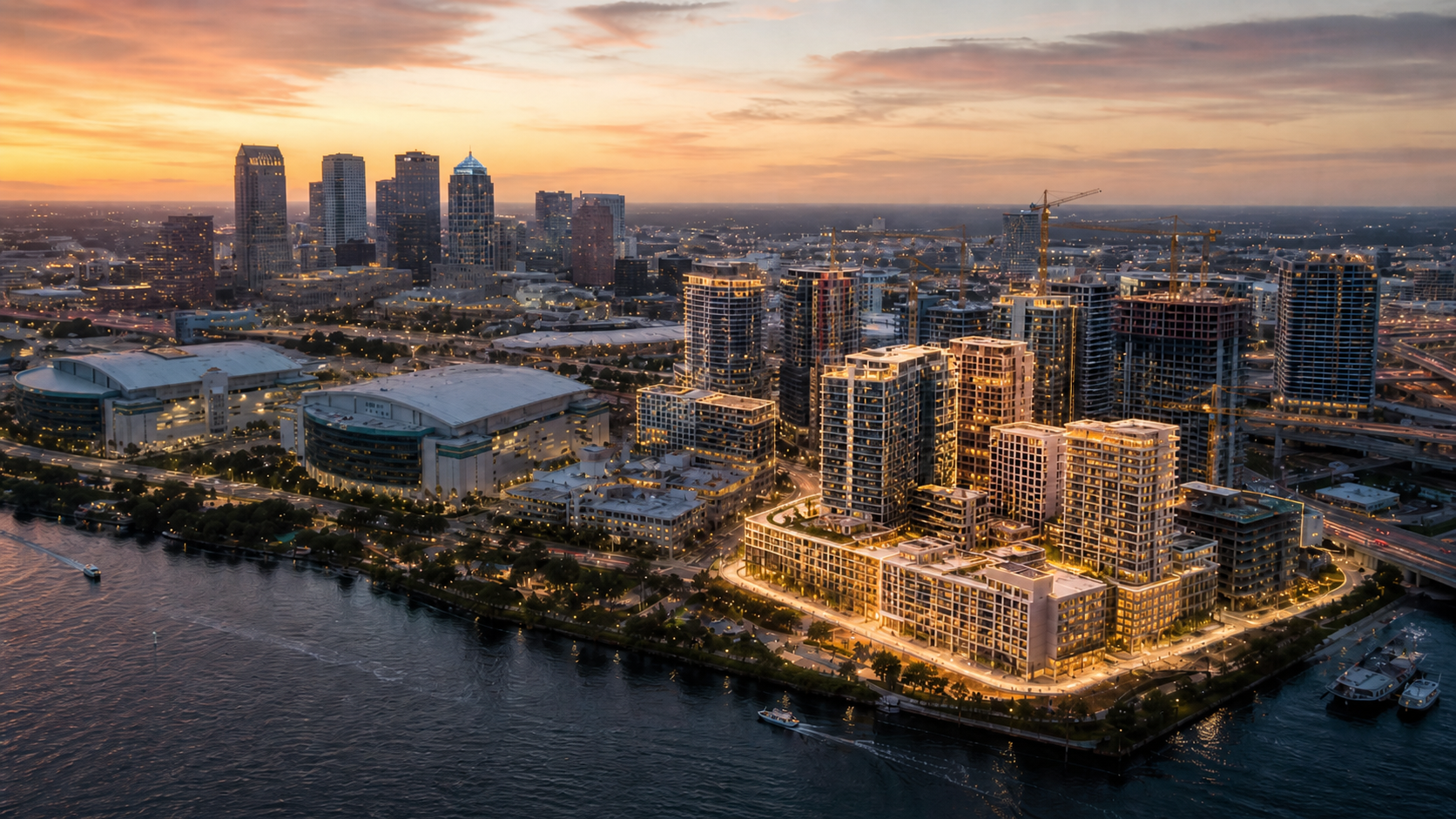
- Large mixed-use developments: Projects like Water Street Tampa, Midtown Tampa, Westshore Marina District, and GasWorx in Ybor City are reshaping key parts of the region and often lift nearby property values over time.
All of these factors help support property values, rental income, and long-term appreciation.
 Main Commercial Property Types in Tampa Bay
Commercial real estate is not just one type of building. There are several property types, and each one comes with different risks, returns, and ways of operating. Here’s how the main sectors are currently performing in Tampa Bay.
Office
Office buildings are where businesses set up their workplaces. By the end of 2025, Tampa Bay’s office market recorded roughly 600,400 square feet of positive net absorption (meaning more space was leased than vacated), the strongest year since 2016. Overall office vacancy improved to about 15.7%, which is 1.3 percentage points lower than the year before.
Top-tier “trophy” and Class A buildings in central areas like downtown Tampa, Westshore, and downtown St. Petersburg are doing even better, with vacancy around 12.9% and average asking rents climbing more than 7% to about $45 per square foot.
Tenants are clearly moving toward modern, high-quality buildings with good amenities and walkable locations. Some suburban flex office (spaces that mix office and light industrial) is also gaining popularity as companies settle into hybrid work patterns.
Investor takeaway:
The office can still be attractive, but you must choose submarkets and specific buildings carefully. Class A buildings in strong locations are safer; older suburban offices are riskier.
Retail
Retail properties include shopping centers, strip malls, and stores. Tampa Bay’s retail market is one of the tightest in Florida. As of late 2025, vacancy was about 3.4%, and in top centers, it was under 3%. Average asking rents were around $27.50 per square foot, with rent growth of about 4.5% over the prior year.
There is very little new retail construction, which keeps supply low. Grocery-anchored centers (shopping centers built around a supermarket), experiential retail (like gyms, entertainment, and dining), and retail next to medical uses are performing especially well. Daily population growth—roughly 170 new residents a day—keeps demand for neighborhood-serving retail strong.
Investor takeaway:
Retail is strong but competitive. Well-located grocery-anchored and neighborhood centers can offer steady, inflation-resistant income.
Industrial
Industrial properties include warehouses, distribution centers, and manufacturing facilities. Tampa Bay’s industrial market has been one of the strongest in the country, but a wave of new construction recently pushed vacancy up to around 7.2% in Q3 2025.
Even so, small-bay warehouses under 50,000 square feet remain very tight, with vacancy near 3.2%. Demand comes from e‑commerce fulfillment, regional distribution, and specialized uses like cold storage for pharmaceuticals. East Tampa and Brandon continue to lead in new leases and absorption.
Developers have started slowing down new construction, with under-construction inventory dropping by about 60% from the previous year. This suggests the market may tighten again as new supply is absorbed.
Investor takeaway:
Industrial is still a strong long-term bet. Smaller warehouses and last‑mile logistics properties are especially attractive because supply is so limited.
Multifamily
Multifamily properties are apartment communities and other residential buildings with multiple units. Tampa Bay’s multifamily sector has just gone through a heavy building phase. About 8,300 new units were delivered in the 12 months through Q3 2025, which pushed vacancy up to 10.3% and caused average rents to slip by about 1.9% to $1,800 per month.
However, new construction is slowing sharply. Only around 3,500 units are expected to be completed in 2026, down from a record 12,500 units in 2024. Combined with ongoing population growth, this slowdown in new supply sets the stage for vacancy to fall and rents to start growing again, likely in late 2026 and 2027.
Investor takeaway:
Multifamily is currently a timing play. Investors with a 3–5 year outlook may find good opportunities while the market is soft if they buy at prices below replacement cost.
Mixed-Use
Mixed-use projects combine several uses—such as apartments, offices, retail, and hotels—into a single development. In Tampa Bay, large mixed-use projects like Water Street Tampa, Midtown Tampa, and Westshore Marina District show that these environments can attract strong tenant demand, higher rents, and premium values.
Investor takeaway:
Most investors get exposure to mixed-use through larger developments or through funds and syndications, rather than by buying one mixed-use property on their own.
Key Submarkets in Tampa Bay
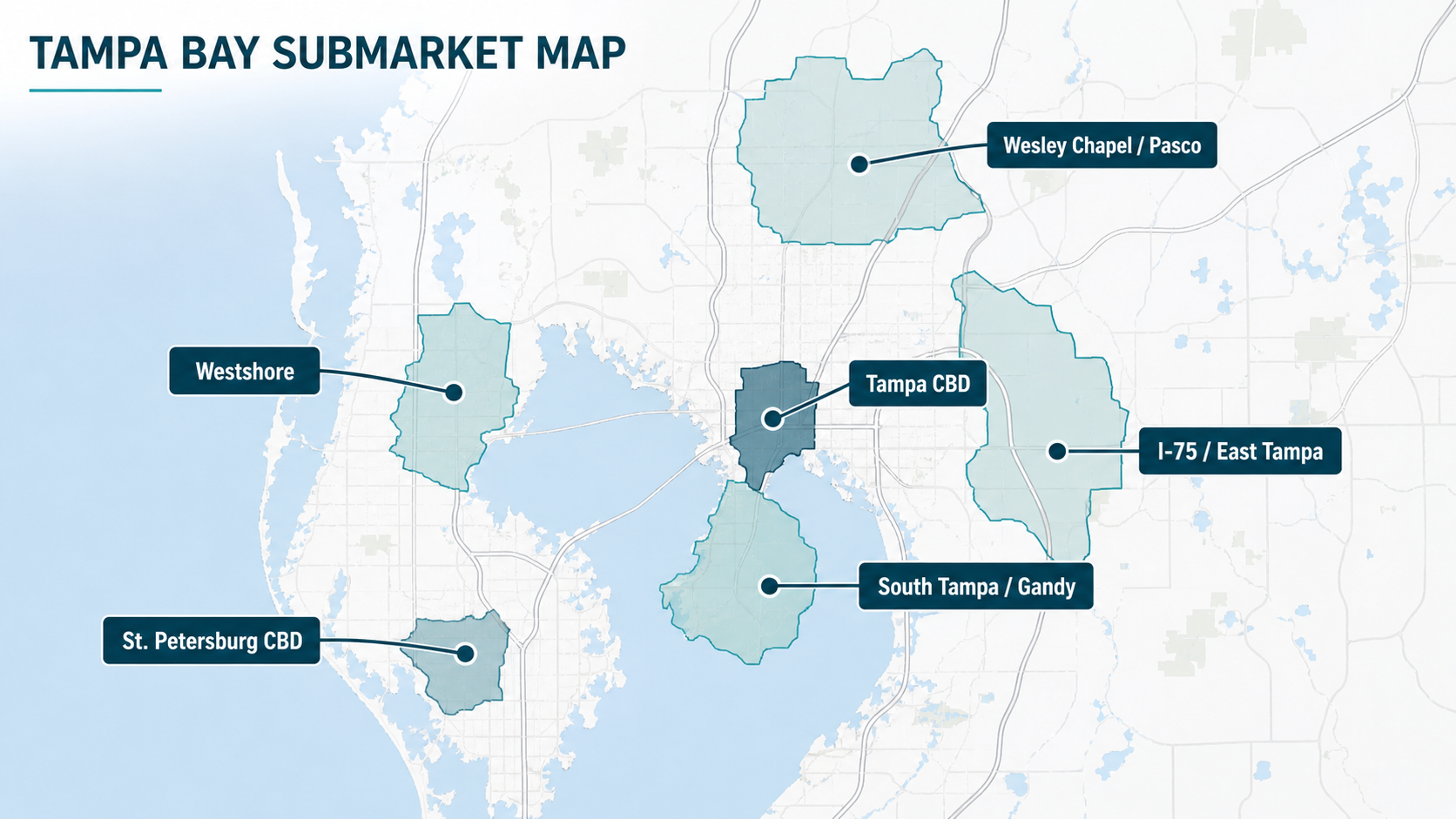
Tampa Bay is made up of multiple smaller markets, often called submarkets. Each submarket has different rents, vacancy levels, tenant types, and growth drivers. Knowing these differences is critical.
Tampa CBD and Channel District
The downtown core is changing fast, thanks to the Water Street Tampa project and nearby developments. Trophy office rents can reach $45+ per square foot, and there is strong residential demand from both young professionals and downsizing retirees. This area has high rents and high-quality assets—but also higher entry prices.
Westshore Business District
Westshore is Tampa Bay’s long-time business hub, with the largest concentration of office space and close access to Tampa International Airport, I‑275, and the Veterans Expressway. The Midtown Tampa development (about 1.8 million square feet of mixed-use space) has added even more appeal to this area.
St. Petersburg CBD
Downtown St. Petersburg has become a lively, walkable urban market, popular with tech companies, creative firms, and professional services. The waterfront, restaurants, and cultural attractions help attract high-paying tenants.
I‑75 Corridor and East Tampa
This area is the industrial engine of the region. Demand for logistics and warehouse space here is driven by e‑commerce, distribution, and pharmaceutical uses. East Tampa and Brandon are the most active industrial submarkets, with low vacancy for modern distribution space.
Pasco County and Wesley Chapel
This is one of the fastest-growing areas, with population up about 19.5% from 2020 to 2025 in some parts, and Wesley Chapel alone growing about 47% since 2020. The surge in residents is driving demand for retail, medical office, and housing. Pasco County issued over 3,200 commercial building permits in 2025, about 34% more than the year before. Lower prices and higher growth potential come with higher execution risk.
South Tampa and Gandy Corridor
These are high-income residential areas with limited commercial properties. The Westshore Marina District is adding density along Gandy. Scarcity and strong demographics support higher property values here.
Key Investment Metrics Every Commercial Real Estate Investor Should Understand
Commercial real estate uses a few core financial metrics. These help you judge the value and performance of a property.
Capitalization Rate (Cap Rate)
The cap rate is a basic return measure:
Cap Rate = Net Operating Income (NOI) ÷ Purchase Price.
It shows the property’s yearly income (before debt) as a percentage of what you paid. In mid‑2025, typical cap rates in Tampa Bay looked roughly like this:
|
Property Type |
Avg. Cap Rate |
|
Multifamily |
5.4%–5.6% |
|
Industrial |
5.5%–5.6% |
|
Retail |
6.4%–6.6% |
|
Office |
6.8%–7.1% |
Sources: Largo Capital Florida CRE Q2 2025 data; Bounat Tampa market reports.
Lower cap rates usually mean the market sees the property as safer and is willing to pay more for each dollar of income. Higher cap rates usually mean higher risk or more management work.
Net Operating Income (NOI)
NOI is the property’s income after operating expenses, but before loan payments and big capital projects.
NOI = Gross Revenue – Operating Expenses (no debt service, no large capital costs).
NOI is the main number used to value commercial property. If you grow NOI by increasing rents, reducing vacancy, or controlling expenses, you increase the property’s value.
Cash-on-Cash Return
Cash-on-Cash Return = Annual Pre-Tax Cash Flow ÷ Total Cash Invested.
This shows how much cash you actually earn each year compared to how much cash you put in. For example, if you invest $200,000 and receive $16,000 in cash flow per year, your cash-on-cash return is 8%.
Many investors aim for 6%–10% on stabilized (steady) properties, depending on the type and how much debt is used.
Internal Rate of Return (IRR)
IRR looks at your total return over time, including both yearly cash flow and what you gain (or lose) when you sell. It also accounts for the timing of these cash flows.
Institutional investors often target:
- 12%–18% IRR for value‑add projects (where they improve the property)
- 8%–12% IRR for core or stabilized assets
Debt Service Coverage Ratio (DSCR)
DSCR = NOI ÷ Annual Debt Service (total yearly loan payments).
Lenders usually want DSCR of at least 1.20x–1.25x. That means the property should make 20%–25% more income than is needed to pay the mortgage. A higher DSCR means more breathing room.
Ways to Invest: Different CRE Investment Vehicles
There are several ways to invest in commercial real estate. The best option depends on how much money you want to invest, how involved you want to be, and how much control you need.
Direct Ownership
With direct ownership, you buy a property yourself (often with a loan) and either manage it on your own or hire a professional manager.
This gives you the most control and the biggest opportunity to increase value through active management. But it usually requires a large amount of capital (often $500,000 or more) and significant time and knowledge.
Syndications
In a syndication, a sponsor (also called an operator) finds a property, arranges financing, and manages the deal. Investors put in money and receive a share of the income and profits.
Minimum investments are usually $50,000–$250,000. Syndications let you own a piece of a larger property without having to manage it day to day.
Commercial Real Estate Funds
A commercial real estate fund pools money from many investors and buys multiple properties. This provides built‑in diversification.
Funds usually focus on certain strategies (like “core,” “value‑add,” or “opportunistic”) and property types. The GPG CRE Fund, for example, focuses on Tampa Bay commercial properties across several sectors and offers professional management plus diversification in a single investment.
Real Estate Investment Trusts (REITs)
Public REITs are companies that own portfolios of income-producing properties and trade on stock exchanges. They must pay out at least 90% of their taxable income as dividends.
REITs are the most liquid way to invest in real estate—you can buy or sell shares quickly. But their prices move with the stock market, and you don’t control which specific properties the REIT owns.
Here is a simple comparison:
|
Vehicle |
Min. Investment |
Control |
Diversification |
Liquidity |
Time Commitment |
|
Direct Ownership |
$500K+ |
High |
Single asset |
Low |
High |
|
Syndication |
$50K–$250K |
Limited |
Single asset |
Low |
Low |
|
CRE Fund |
$50K–$250K |
Limited |
Multiple assets |
Low–Medium |
Low |
|
Public REIT |
~$100+ |
None |
Multiple assets |
High |
None |
(IMAGE HERE – Concept: Clean diagram showing four “paths” into CRE: Direct Ownership, Syndications, CRE Funds, REITs, with small icons and 1–2 words about control and liquidity under each.)
Due Diligence: How to Review a Tampa Bay CRE Deal
Due diligence is the research you do before investing. Whether you’re buying a property or investing passively in a fund or syndication, this step is critical.
Market-Level Analysis
At the market level, look at:
- Vacancy rates and how they’re trending
- Rent growth and new construction supply
- Population and job growth in the area
- Infrastructure projects and major employers nearby
Different Tampa Bay submarkets—like Downtown Tampa, Westshore, and the I‑75 corridor—have very different patterns. For a detailed breakdown, see the Tampa Bay CRE Market Report: Q1 2026.
Property-Level Analysis
At the property level, focus on:
- Physical condition: Roof, HVAC, structure, and environmental issues (a Phase I Environmental Site Assessment is often the starting point).
- Tenants: Their credit strength, how long they have left on their leases, how likely they are to renew, and whether income depends heavily on just one or two tenants.
- Financials: Actual income and expenses for at least the last 12 months, compared to the projections, and how the expense ratios compare with similar properties.
- Legal/regulatory issues: Zoning, entitlements, ADA compliance, and Florida building code requirements.
- Insurance and resiliency: Wind and flood insurance costs and whether the property is in a high-risk flood zone.
Sponsor/Operator Evaluation (for Passive Investors)
If you’re investing in a syndication or a fund, you’re also investing in the sponsor’s skills and integrity. Look at:
- Past deals and realized returns
- How much of their own money do they put into the project
- Their fee structure (how they get paid)
- How often and how clearly they communicate with investors
Tax Benefits of CRE Investing
Commercial real estate can offer strong tax advantages, which can increase your after-tax returns. Always talk to a tax professional, but here are some of the main benefits.
Depreciation
The IRS lets you depreciate (spread out the cost of) commercial buildings over 39 years and residential rental buildings over 27.5 years. A cost segregation study breaks the building into parts that can be depreciated faster.
These non-cash deductions can offset taxable rental income, lowering your effective tax rate.
1031 Exchanges
A 1031 exchange lets you sell one investment property and buy another similar property, while deferring (delaying) capital gains taxes.
You must:
- Identify the replacement property within 45 days
- Close on it within 180 days
Many Tampa Bay investors use 1031 exchanges to trade into larger, professionally managed properties. For more details, see the IRS page on Like-Kind Exchanges Under IRC Section 1031..
Opportunity Zones
The 2017 Tax Cuts and Jobs Act created Opportunity Zones to encourage investment in certain lower-income areas. Tampa Bay has Opportunity Zones in East Tampa, parts of Ybor City, and parts of St. Petersburg.
If you invest through a Qualified Opportunity Fund (QOF), you can:
- Defer capital gains taxes from another investment
- Potentially reduce the amount of tax owed
- Potentially avoid tax on new gains from the QOF if you hold the investment for at least 10 years
Pass-Through Deduction (Section 199A)
Many real estate investments are held in pass‑through entities like LLCs. Under Section 199A, some investors can deduct up to 20% of qualified business income, which may further reduce taxes on rental income.
Tax rules are complex and personal. Always work with a CPA or tax attorney who specializes in real estate to build the right plan for you.
Risk Management in Commercial Real Estate
All investments have risk, and commercial real estate is no exception. Good investors focus on understanding and managing those risks, not avoiding them altogether.
Market Risk
Property values and rents can rise and fall with the economy, interest rates, and local supply and demand. Diversifying across property types and locations and focusing on strong-growth markets like Tampa Bay can help.
Tenant Risk
If tenants leave or stop paying, income drops. You can reduce this risk by:
- Choosing strong tenants
- Avoiding too much dependence on any one tenant
- Staggering lease expirations
- Budgeting for a vacancy
Interest Rate Risk
When interest rates rise, loans cost more, and prices can come under pressure. Using fixed-rate loans when possible, keeping leverage at reasonable levels (for example, 60%–65% loan-to-value), and stress-testing your numbers at higher rates can help.
Concentration Risk
Putting too much of your capital into one property, tenant, or market increases downside risk. You can respond by building a more diversified portfolio or using funds that provide built‑in diversification.
Liquidity Risk
Real estate is illiquid, meaning it can take time to sell—especially in a weak market. Plan to hold for several years, keep cash reserves for surprises, and make sure your total CRE exposure is a reasonable part of your overall net worth.
Insurance and Climate Risk
Tampa Bay’s coastal location means exposure to hurricanes, strong winds, and flooding. Investors need to:
- Buy proper wind and flood insurance
- Understand FEMA flood maps and zones
- Factor insurance costs into their financial models
- Prefer properties with modern construction and wind-resistant features when possible
Local Advantages of Tampa Bay for CRE Investors
Beyond general growth, Tampa Bay has several local factors that make it attractive:
- Better yields than South Florida: For similar assets, cap rates in Tampa Bay are often 0.50–1.00 percentage points higher than in Miami-Dade and Broward, meaning better income for the same dollar of purchase price.
- Major infrastructure projects: The I‑275 widening, airport expansion, and Port Tampa Bay deepening create long-term value for nearby properties and support job growth.
- Emerging submarkets: Areas near GasWorx in Ybor City, the expansion of Water Street Tampa, and the Wesley Chapel corridor in Pasco County (which grew around 19.5% recently) offer strong growth potential.
- Growing institutional interest: More national institutional investors are active in Tampa Bay, which usually brings more liquidity and helps mature the market.
- Pro-business environment: Florida and local governments in Tampa Bay are generally supportive of business and development, which reduces friction for investors.
Key Takeaways
- Tampa Bay is one of the fastest-growing metro areas in the U.S., with nearly 400,000 new residents expected by 2030, creating strong demand for commercial space.
- Each property type—office, retail, industrial, multifamily, mixed-use—has its own mix of risk and reward. Today, retail and small-bay industrial are especially tight, while multifamily is working through a temporary oversupply.
- Core metrics like cap rate, NOI, cash-on-cash return, and IRR are central to evaluating any CRE investment.
- You can invest directly, through syndications, through CRE funds, or through REITs, depending on your desired control, diversification, and liquidity.
- Tax tools such as depreciation, 1031 exchanges, Opportunity Zones, and the 199A pass‑through deduction can significantly boost after-tax returns when used correctly.
- Strong due diligence—on the market, the specific property, and the sponsor—should never be skipped.
- Managing risk through diversification, conservative borrowing, and proper insurance is essential for protecting long-term wealth.
Related Reading
Industry resources you may find helpful:
Ready to Explore Tampa Bay CRE Investment?
Gain Property Group helps accredited investors gain access to institutional-quality commercial real estate in Tampa Bay through its CRE Fund, brokerage services, and deep local market knowledge.
Whether you’re looking at your first commercial property or adding to an existing portfolio, GPG provides the data, transparency, and on-the-ground insight you need to make informed decisions.
You can schedule an investor consultation to talk about your goals, your risk tolerance, and how Tampa Bay commercial real estate might fit into your overall investment strategy.
