Every commercial building has a capital plan. Most owners just have not written theirs down, so it arrives one invoice at a time and each one is a surprise. The roof, the rooftop units, the parking lot and the elevators will all be replaced on roughly the schedule their age dictates, whether or not anyone wrote the schedule out. The only question is whether the owner sees it coming.
This is the ninth article in a series on how to read your own building. The first article put capital reserves below NOI as one of the lines a listing never shows. This one is about the page that tells you how big that line should be.
One page is enough
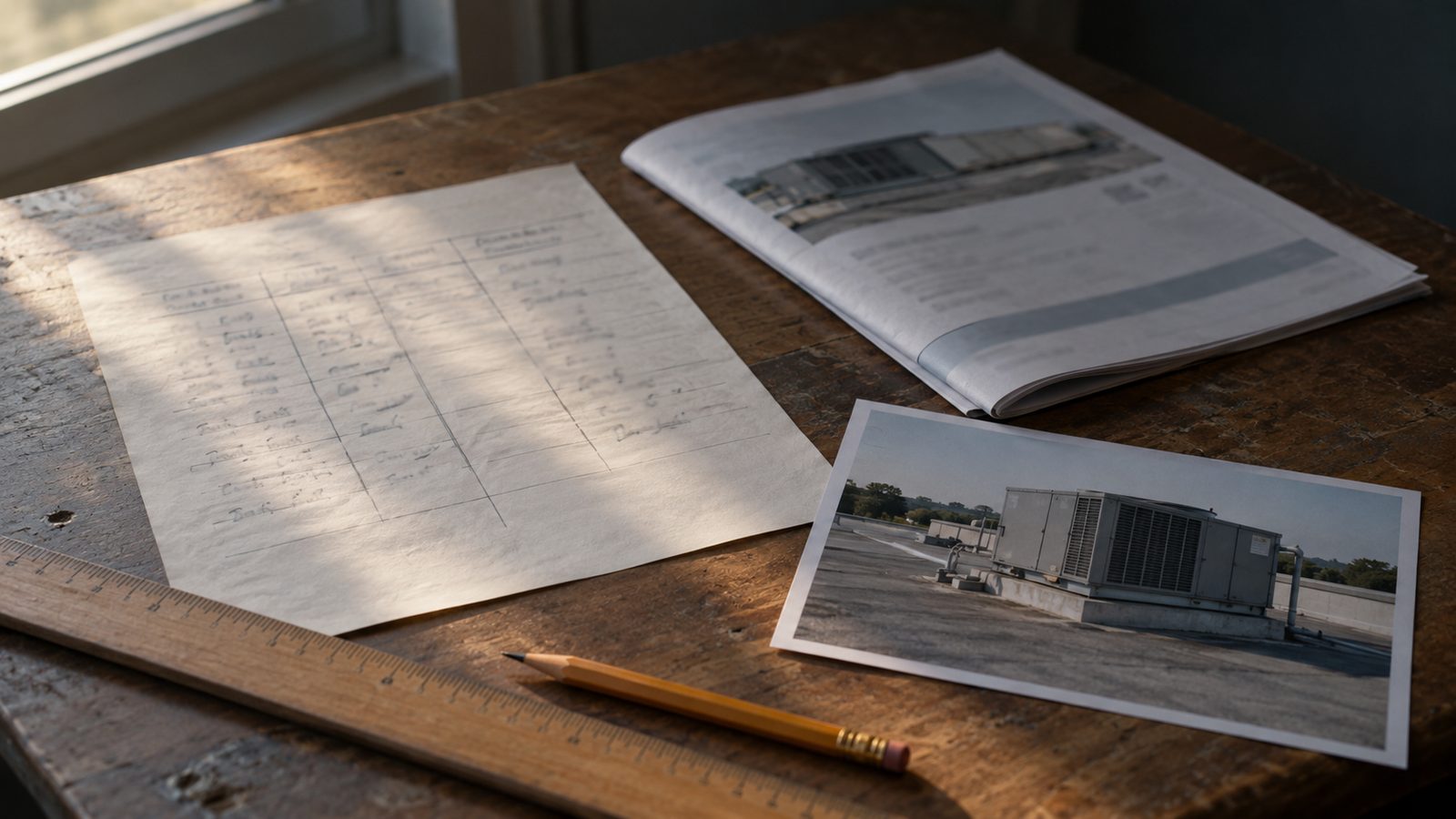
The plan is a table. Down the side, the building's major components: the roof; the rooftop HVAC units, one line each if there are only a few; the parking lot, with sealcoating and resurfacing as separate lines because they run on different clocks; the elevators, if any; the exterior envelope, meaning paint, sealant and windows; the fire alarm and sprinkler systems; and the water heaters and the main plumbing and electrical gear if they are old enough to matter.
Across the top, four columns: the year the component was installed or last replaced, its expected life, a rough replacement cost, and the year it comes due. The installed year comes from the permit history, the closing file or the contractor who did the work. The expected life comes from the manufacturer or the contractor who inspects it. The cost comes from a contractor's quote or a recent job on a comparable building, rounded, not from a national cost guide.
Sort the table by the year due. That is the plan. It takes an afternoon, most of it on the phone with the roofer and the HVAC contractor, and once it exists it takes an hour a year to keep.
What it changes
Everything downstream of it.
The reserve. Add up what comes due in the next five years and divide by five. That is the annual reserve the building actually needs, and it can be compared directly with what is being set aside today. The gap between the two is the plan's first finding, and it is usually large, because reserves are set by habit and replacements are set by physics.
The rent. A building that needs a new roof in three years needs the renewals signed in the meantime to carry it, which changes what the owner can concede on a renewal and what a slightly higher rent is for. The plan turns "we need more rent" into "we need this much, by then, for this".
The refinance. Lenders underwrite a reserve and ask about the roof. An owner who refinances a year before the roof is due has borrowed against a building the lender will discount; one who times the loan to fund the roof has borrowed against a building the lender can see improving. The plan is what makes the timing a choice.
The sale. A buyer prices the unknown at the worst case. A written plan with reserves against it removes the unknown, and the buyer's engineer, who will produce the same table during due diligence, finds nothing the owner did not already disclose. A building with the plan is worth more than the same building without it, for no other reason than that the buyer is no longer guessing.
Two earlier articles in this series connect here. The roof file from the sixth article is the first row of this table, and the capital items from the seventh are the ones that must not quietly reappear in the tenants' reconciliation.
A worked example
The figures are illustrative, not a property we manage, and the service lives are assumptions for the example rather than a schedule for any real building.
A 25,000-square-foot office building, held for eight years. The owner has been reserving $0.50 per square foot a year, $12,500, into a separate account, which felt prudent. The one-page plan, built in an afternoon:
- Exterior paint and sealant: last done nine years ago, assumed ten-year cycle, $45,000, due next year.
- Parking lot resurfacing: original asphalt, assumed twenty-year life, $120,000, due in two years. Sealcoating, $12,000, on a four-year cycle, due the same year.
- Six rooftop HVAC units: installed twelve to fourteen years ago, assumed fifteen-year life, $18,000 each, $108,000, due in years three to five.
- Fire alarm panel: original, assumed twenty-five-year life, $25,000, due in year five.
- Roof: replaced seven years ago, assumed twenty-year life, $300,000, due in year thirteen, outside the window.
Due within five years: $310,000. The reserve at $12,500 a year will have added $62,500 by then. The shortfall is roughly $250,000, and the plan found it in an afternoon, three years before the first large invoice.
That number is not a crisis. It is a set of choices. Raise the reserve to about $2.50 per square foot. Time a refinance to the year the lot and the first units come due. Ask the HVAC contractor which units can be carried a few more years on a documented service program, and which cannot. Carry the exterior work into the next two renewals. Any of those works. What does not work is finding the number in year two, when the lot fails and the first unit goes down in the same summer.
What to do with this
Build the table this month. Call the roofer and the HVAC contractor for the two numbers you cannot estimate yourself. Sort by year due, add up the next five years, divide by five, and put that figure next to what you reserve today.
Then put the page in the same folder as the roof file and the operating-expense sheet from earlier in this series. Those three pages, kept current, are most of what a lender, an insurer and a buyer will ask for, and all of what an owner needs to stop being surprised by their own building.
About this series
Gain Property Group manages office, retail, industrial and multifamily property across Hillsborough, Pinellas, Pasco, Polk, Manatee and Sarasota counties. We also own commercial buildings ourselves, in other markets, so we read these numbers the way an owner does.
If you own commercial property in Tampa Bay and want a second set of eyes on the capital plan, or help building the first one, request a free management assessment. In writing, no obligation, whether or not you change managers.
This article is general information about commercial property operations. It is not investment, legal or tax advice.