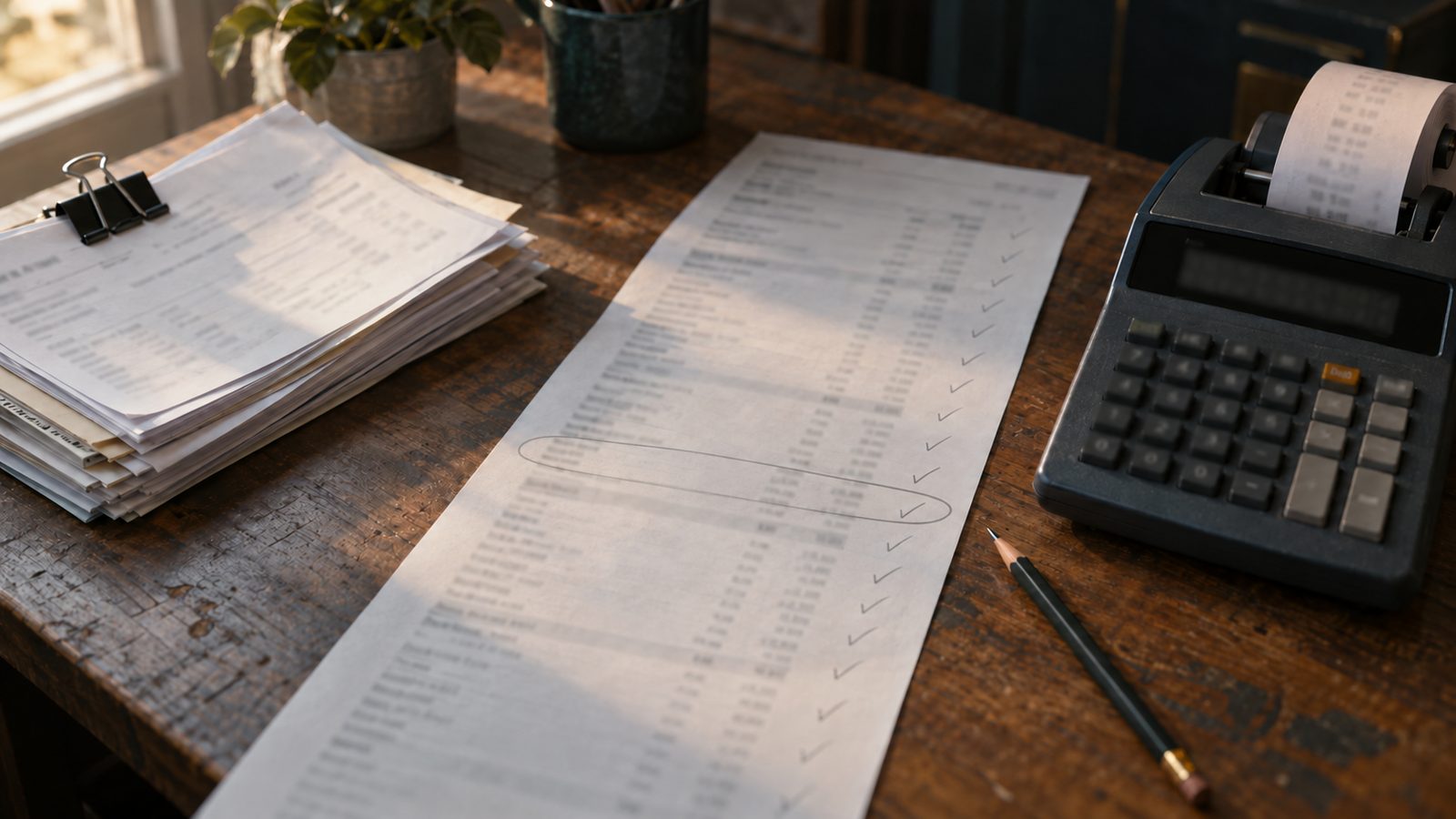
The annual CAM reconciliation is where owner and tenant relationships go wrong, and it is almost never about the money. It is about whether the tenant can check the math. A reconciliation that arrives as a total, a percentage and an invoice gets disputed because it cannot be verified, and the tenants who can afford to verify it will.
This is the seventh article in a series on how to read your own building. The third article put the five operating lines on one sheet, per square foot. This one is about the document that passes those lines through to the tenants, and why the way it is built matters more than the number at the bottom.
What the reconciliation is
On a triple-net or modified-gross lease the tenant pays, on top of base rent, a share of the building's operating costs: common-area maintenance, property tax, insurance, and whatever else the lease defines as recoverable. Through the year the tenant pays an estimate, usually monthly, based on the budget. After the year closes, the owner totals the actual costs, works out each tenant's share, and bills or credits the difference. That annual settling-up is the reconciliation.
It is the one document each year in which the owner tells every tenant what the building cost to run and asks them to pay for it. Most leases set a deadline for it, often a stated number of days after the year ends, and most give the tenant a window to question it. Both are in the lease, and both are routinely missed by managers who treat the reconciliation as bookkeeping rather than as a statement to a customer.
The three parts of a clean one
A reconciliation a tenant can check has three parts, and each one answers a question the tenant would otherwise have to ask.
The first is the year's actual expenses by category, in the same categories the lease uses to define what is recoverable. Not one line reading "operating expenses" but tax, insurance, landscaping, repairs, management and so on, with the budget next to each actual so the variance is visible.
The second is the tenant's share, shown as a calculation rather than a result: the tenant's square footage, the denominator the lease defines, and the resulting percentage. The denominator is where many disputes start. Some leases divide by the rentable area of the whole building; some divide by the leased area; some gross up the variable costs as though the building were a stated percentage occupied. The lease says which. The reconciliation should show it.
The third is the difference against what the tenant paid in estimates: estimates billed, estimates received, actual share, balance due or credit owed. One page, three blocks, and the tenant can follow every number from the invoice back to the lease.
A messy reconciliation has the same information compressed into three lines. It is not wrong more often than the clean one. It is disputed more often, because nobody can tell whether it is wrong.
The two lines that come out at audit
Many commercial leases give the tenant an audit right: a window, usually measured in months after the reconciliation arrives, in which the tenant or an accountant working on their behalf may examine the books behind it. Tenants who exercise the right look for the same two things first, because both are common and both are recoverable.
Capital items run through operating costs. A parking lot resurfaced, a roof section replaced, rooftop units swapped out: these are capital, and most leases either exclude them from recoverable costs or allow them only when amortised over their useful life, sometimes only when they reduce operating costs or are required by a change in the law. A manager who books the whole invoice to repairs and passes it through in one year has overcharged every tenant in the building, and the audit will find it in the first hour.
The management fee calculated on the wrong base. The lease defines what the fee may be charged against, and leases differ: some allow a fee on base rent, some on gross receipts including the recoveries, some cap it as a share of the operating costs themselves. Property-management software applies a default, and the default is often not what the lease says. On one tenant the difference is small. Across a building and across years it is not.
Both errors are usually honest. Both are the tenant's money. Under many audit clauses, if the overcharge exceeds a threshold the lease sets, the owner also pays for the audit, and in every case the owner pays in trust at the next renewal.
A worked example
The figures are illustrative, not a property we manage.
A 40,000-square-foot retail center. One tenant occupies 5,000 square feet, a 12.5 percent share under a lease that uses the center's full rentable area as the denominator, allows capital items only when amortised over their useful life, and defines the management-fee base as base rent.
The year's estimates were set at $6.00 per square foot, so the tenant paid $30,000. The reconciliation as first prepared shows total recoverable costs of $284,000, or $7.10 per square foot. The tenant's share is $35,500, and the balance due is $5,500.
Inside the $284,000 are both of the lines above.
- A $40,000 parking-lot resurfacing booked to repairs. The lease allows it only amortised over its useful life, ten years in this example, so $4,000 belongs in this year and $36,000 does not.
- A management fee of $14,200, calculated by the software on gross receipts including the recoveries. On base rent, the base the lease defines, it comes to $11,600. The difference is $2,600.
Corrected recoverable costs: $284,000, less $36,000, less $2,600, is $245,400, or about $6.14 per square foot. The tenant's share is $30,675. The balance due is $675, not $5,500.
Across the whole center the overstatement is $38,600, spread over every tenant in proportion to their share. A tenant who audits recovers their part of it. The others pay it, unless the owner catches it first, which is the point of reading the reconciliation before it goes out.
What to do with this
Read your own reconciliation the way an auditing tenant would, before it is mailed. Take the actuals by category and mark every invoice over a threshold you choose, say $5,000, and ask of each one whether it was a repair or a replacement. Take the management-fee line and check the base against the lease. Take the denominator and check it against the lease. Thirty minutes on a small building.
Then look at the format. If a tenant could not follow your reconciliation from the invoice back to the lease without calling you, rebuild it in three blocks. The money will not change. The number of phone calls will.
A reconciliation that is late, or that tenants dispute every year, is also one of the signs an owner should watch for in how the building is being run. That list is the subject of a later article in this series.
About this series
Gain Property Group manages office, retail, industrial and multifamily property across Hillsborough, Pinellas, Pasco, Polk, Manatee and Sarasota counties. We also own commercial buildings ourselves, in other markets, so we read these numbers the way an owner does.
If you own commercial property in Tampa Bay and want your reconciliations read the way an auditing tenant reads them, request a free management assessment. In writing, no obligation, whether or not you change managers.
This article is general information about commercial property operations. It is not investment, legal or tax advice; your lease governs.