-p-1080-4.webp)
Commercial real estate has long appealed to investors looking for stable income, tax efficiency, and long-term appreciation. But not every strategy offers the same risk-return profile. One of the clearest distinctions in the market is the difference between buying a fully stabilized asset and acquiring a property with room for meaningful operational improvement.
That is where value-add commercial real estate stands apart.
Rather than paying top-of-market pricing for a property that has already been optimized, value-add investors seek assets that are underperforming for identifiable reasons and then work to improve them through execution. When that approach is disciplined, it can create something especially attractive: asymmetric upside.

What Is Value-Add Commercial Real Estate?
Value-add commercial real estate refers to properties that are not operating at their full potential. These assets may be underperforming relative to the market, poorly managed, leased below market, financially distressed, in need of physical improvements, or owned by a motivated seller.
In other words, the opportunity is not simply in owning the real estate. The opportunity is in improving it.
Instead of buying peak performance, value-add investors buy a problem they believe they can solve. That discount at acquisition, combined with a clear plan to increase performance, is what creates the potential for outsized returns.
Core vs. Value-Add: What Is the Difference?
Core investing typically involves lower-risk, fully stabilized properties with dependable cash flow and limited room for major operational improvement. These assets usually trade at market pricing because much of the upside has already been realized.
Value-add investing is different. It involves more complexity, a stronger execution burden, and a more hands-on strategy. But in exchange, investors may gain a discounted purchase basis, multiple levers for improving performance, and a much broader path to value creation.
The key difference is control.
Core investments often depend more heavily on market conditions and natural appreciation. Value-add strategies rely on actively creating value through operations, leasing, and asset management. That is not speculation. It is execution.
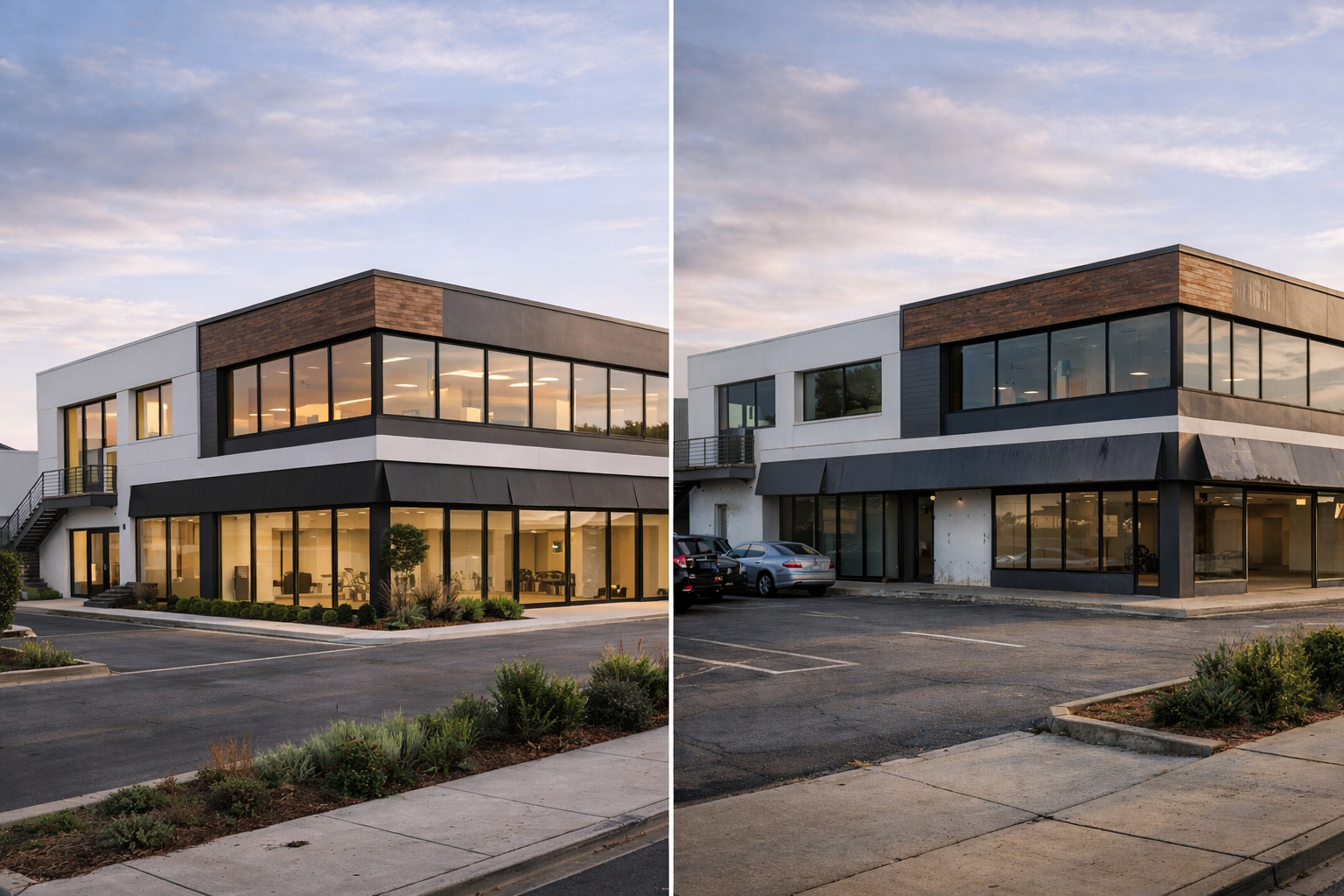
How Value-Add Commercial Real Estate Creates Asymmetric Upside
Asymmetric upside means the potential gains can materially outweigh the downside when a deal is structured correctly. In value-add commercial real estate, that dynamic often comes from three places.
Buying at a Strong Basis
A disciplined purchase price is the first layer of downside protection. When an investor acquires a property below replacement cost or below its intrinsic potential value, the margin for error improves.
Buying well does not eliminate risk, but it can reduce exposure before the business plan even begins. A strong basis creates flexibility, especially when market conditions become less predictable.
Growing Net Operating Income
In commercial real estate, value is largely driven by income. When Net Operating Income, or NOI, increases, property value often follows.
That improvement can come from several operational changes: retaining tenants more effectively, improving leasing strategy, adjusting below-market rents, reducing unnecessary expenses, or addressing deferred maintenance in a more proactive way.
This is where value-add investing becomes especially powerful. The upside is not dependent only on outside market appreciation. It is created internally through better performance.
Executing Toward a Strategic Exit
Most value-add strategies are built around a defined hold period, often five to seven years. That timeline allows the operator to stabilize occupancy, improve the physical asset, optimize rents, and strengthen overall financial performance.
A clear hold strategy matters because it reduces guesswork. The plan is not to wait and hope. The plan is to improve the property in measurable ways and then create optionality at exit, whether through a sale, a refinance, or continued ownership under better economics.
Why Execution Matters More Than Market Noise
It is easy to get distracted by headlines. Interest rates, cap rates, and economic uncertainty all matter. But in many value-add deals, the bigger driver of results is execution.
Poor operations can erode returns quickly. Strong operations can create value even in less-than-perfect environments.
That is why disciplined investors pay close attention to the fundamentals that are within their control: conservative underwriting, real operational inefficiencies, smart capital structure, and consistent day-to-day asset management.
Value-add investing is not passive appreciation. It is an active transformation.
The Real Risks of Value-Add Investing
It is important to be direct about this: value-add investing is not risk-free, and understanding the biggest risks in commercial real estate is part of evaluating any opportunity well
Renovations can take longer than expected. Costs can rise. Leasing assumptions can prove too optimistic. Market conditions can shift before the business plan is complete.
The goal is not to pretend those risks do not exist. The goal is to manage them intelligently.
Strong operators typically do that by underwriting conservatively, maintaining contingency reserves, buying at a disciplined basis, diversifying tenant exposure where possible, and keeping tight operational oversight throughout the hold period.
Risk does not disappear in value-add commercial real estate. But it can be identified, structured, and managed with discipline.

Why Some Investors Miss the Opportunity
Value-add investing can look more complicated than buying a stabilized property because it is more complicated. But complexity is often where the opportunity lives.
When a sponsor has clear acquisition criteria, structured capital deployment, operational expertise, and a defined exit plan, that complexity becomes much more manageable. And when complexity is handled well, the upside can be significant.
For many investors, the challenge is not that value-add is inherently too risky. It is that value-add requires real execution capability.
Why Passive Investors Should Still Think Like Operators
Even passive investors benefit from understanding how to think like an operator before evaluating a commercial real estate opportunity.
Before investing in any opportunity, it helps to ask practical questions. What is the plan to increase NOI? What inefficiencies exist today? Is the purchase basis strong enough to help protect the downside? What happens if the market softens? Who is responsible for execution at the property level?
The best sponsors think about risk before returns. They focus on operational clarity before projecting upside. That discipline is often what separates a compelling strategy from a speculative one.
Final Thoughts
Value-add commercial real estate is not about chasing appreciation for its own sake. It is about buying intelligently, improving intentionally, managing proactively, and exiting strategically.
When executed well, this approach can create meaningful upside while still maintaining a clear view of risk. In an environment where discipline matters more than ever, that combination is what makes value-add such a compelling strategy.
